
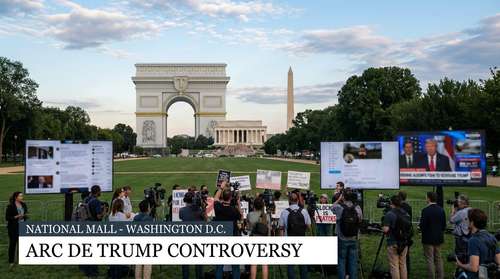
Washington, D.C. is certainly no stranger to towering marble monuments or larger-than-life political ambitions, but nothing could have prepared the capital's skyline for the latest development. On April 10, 2026, the U.S. Commission on Fine Arts reviewed detailed renderings for a 250-foot triumphal arch—promptly dubbed the Arc de Trump—slated to be constructed between the Lincoln Memorial and Arlington National Cemetery. For observers tracking the wildest developments in American politics, this ranks as the undisputed peak of funny political news 2026. The massive proposal has immediately turned the national airspace into a battleground of fierce debate and absolute internet hilarity.
A 250-Foot Colossus: Breaking Down the Triumphal Arch Plans
Officially referred to in government documents as the Independence Arch, the project was originally conceptualized to celebrate America's 250th anniversary in July 2026. However, the public has universally agreed on its catchier moniker. This sprawling Trump monument Washington DC has been proposed for Memorial Circle, right on Columbia Island. To understand the sheer magnitude of the project, you have to look at the numbers. Rising 250 feet into the air—one foot for every year of American independence—the structure would entirely dwarf the iconic 164-foot Arc de Triomphe in Paris.
Proponents of the monumental gateway argue that the capital has long lacked a grand architectural celebration of American victory. However, art critics and architectural historians who examined the latest triumphal arch plans were left scratching their heads. The design is a sprawling neoclassical hodgepodge that borrows elements from across the globe, creating a visual spectacle that has instantly triggered an avalanche of weird architecture memes across social media platforms.
The Golden Goddess and Borrowed Lions
The main body of the arch is designed to rise 166 feet from a highly elevated base, but the true crown jewel sits at the very top. Renderings show a 60-foot-tall gilded statue that critics have gleefully compared to a bizarre AI mash-up between the Statue of Liberty and the Greek goddess Nike. Throw in four massive eagles and a pair of stone lions that look suspiciously identical to the ones guarding the New York Public Library, and you have a recipe for trending LOL news. Social media users have spent the last 48 hours photoshopping the monument into various historical and cinematic backgrounds, cementing its status as a viral sensation.
Fast-Tracking Through the Fine Arts Commission
How does a monument of this scale get pushed through the notorious bureaucratic gridlock of Washington? It helps to have dedicated allies on the inside. Following his return to office, the president quickly reappointed loyalists to key oversight boards, including tapping Rodney Mims Cook Jr. to chair the U.S. Commission on Fine Arts. Critics point out that standard monuments—such as the recently approved Women's Suffrage Monument—typically spend years navigating feasibility studies, environmental reviews, and public comment periods before a single shovel hits the dirt.
In contrast, the Arc de Trump has seemingly been placed on a bureaucratic bullet train. According to reports from architectural watchdogs, previous reviews for projects of this magnitude required up to 18 months of rigorous engineering scrutiny. The new arch renderings were reportedly deliberated for a mere fraction of that time. This rapid-fire approval process has only poured gasoline on the ongoing National Mall controversy, fueling accusations that independent panels are acting as rubber-stamp committees.
Veterans and Lawmakers Push Back
Beyond the laughs and the digital mockery, a very real legal and political battle is brewing. The proposed location directly intersects the symbolic sightline connecting the Lincoln Memorial to the Arlington House, the final resting place for countless American veterans.
Just weeks prior to the latest rendering release, the advocacy group Public Citizen filed a federal lawsuit on behalf of three Vietnam War veterans to halt the project. Lawmakers have joined the fray, arguing that constructing a monument of this unprecedented scale on federal land requires a direct act of Congress. Opponents claim the towering structure fundamentally perverts the somber, reflective nature of the Arlington Memorial Bridge corridor, a space historically dedicated to post-Civil War reconciliation and quiet mourning. In their recent court filings, Democrats warned that allowing the construction to proceed could lead to an "unchecked proliferation" of presidential vanity projects dominating the district's public spaces.
Will the Arch Actually Be Built?
Despite the legal roadblocks and the chorus of architectural purists tearing the design apart, the momentum behind the project remains uniquely persistent. Private funding is reportedly being funneled through specialized trusts to bypass congressional purse strings, setting up a monumental clash between the executive vision and judicial oversight. With the semiquincentennial deadline of July 4, 2026, rapidly approaching, the construction timeline looks incredibly tight.
Whether it eventually breaks ground or remains a legendary unfulfilled blueprint, the monument has undeniably achieved one major victory: it has thoroughly captivated the public's attention. As federal courts prepare to hear the injunctions and the commission fields intense public scrutiny, the architectural saga promises to dominate both legal dockets and late-night television. The debate over this towering colossus will undoubtedly continue to supply the internet with endless entertainment while keeping the American public firmly watching the skies over the Potomac.