
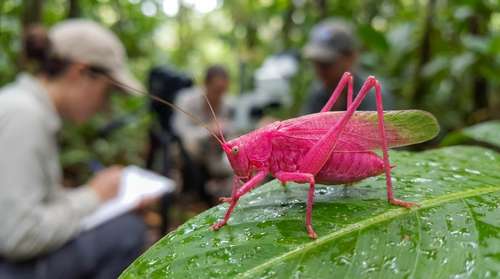
Imagine wandering through the dense, shadowy jungles of Central America at midnight, only to spot an insect rocking a neon pink outfit that would put Barbie to shame. This exact scenario played out at the Smithsonian Tropical Research Institute's field station on Barro Colorado Island in Panama, sparking one of the most fascinating scientific revelations of the year. Researchers have documented a spectacular hot pink katydid undergoing a complete transformation, morphing into a perfectly camouflaged green leaf over just 11 days. This stunning Arota festae discovery is officially headlining weird nature news 2026, completely overturning what entomologists previously believed about brightly colored rainforest bugs.
The Arota Festae Discovery That Rewrote the Rules
When lead researcher Dr. Benito Wainwright and his team from the University of St Andrews first spotted the vivid adult female Arota festae under a research station light, they thought they had found a bizarre genetic quirk. Leaf-masquerading katydids, often colloquially called bush crickets, typically sport a deep green hue to blend in with foliage. Finding a hot pink specimen—measuring just 27 millimeters long and weighing a single gram—was a genuine surprise.
Curious to study this apparent mutation, the team captured the tiny insect and observed her in an enclosure mimicking natural ambient conditions. What happened next solved a longstanding animal camouflage mystery. By day four, her intense neon exterior had faded to a softer pastel. By day 11, the pink bug color change was complete: she had become flawlessly green. The katydid was completely indistinguishable from the rest of her emerald-toned peers.
Debunking the Mutation Myth
Naturalists have occasionally documented these flamboyant pink katydids since at least 1878. For over a century, the scientific community assumed these colorful anomalies were victims of erythrism—a rare, non-competitive genetic mutation comparable to an insect version of albinism. Experts believed this neon coat was a severe disadvantage, making the insects an easy, high-visibility snack for hungry bats, birds, and lizards. The recent findings, published in the journal Ecology, prove this long-held theory entirely wrong. This marks the very first time an adult katydid has been recorded completing a full color shift within a single life stage.
Solving the Animal Camouflage Mystery: Delayed Greening
Why would an insect trying to stay hidden in a lush tropical forest dress like a worker in a high-visibility jacket? The answer lies in the dynamic lifecycle of the jungle canopy itself.
Researchers realized the katydid's hot pink phase is actually an elite survival strategy evolved to track the precise life cycle of the vegetation it mimics. In tropical environments, a phenomenon known as "delayed greening" or "red flushing" is remarkably common. New, budding leaves often emerge in vivid shades of white, red, or bright pink before their chlorophyll kicks in and they mature into standard green leaves.
Hiding in Plain Sight
On Barro Colorado Island alone, roughly 36 percent of native plant species display this delayed greening trait. Interestingly, botanists believe these vividly colored juvenile leaves are actually less nutritious to herbivores, meaning their unappetizing color helps them survive to maturity. For a tiny, vulnerable insect, blending in with these bright, widespread young leaves—like those of the native Inga ruziana plant—is an evolutionary stroke of genius. The insect seamlessly shifts its wardrobe to match the aging foliage, proving that Panama rainforest insects possess adaptation skills far beyond our previous understanding.
The Mechanics Behind the Pink Bug Color Change
Unlike chameleons or cephalopods, which can alter their appearance in seconds using rapid nerve signals and specialized cells, the katydid’s transformation is a slow, methodical process. The gradual pigment shift takes nearly two weeks, perfectly pacing the natural aging timeline of the surrounding pink leaves turning green.
The scientific photographs that sparked a viral nature video showcase this incredible biological feat. Viewers can watch the vivid roseate hue drain away, replaced by the precise vein-like patterns and deep green coloring of a mature leaf. It highlights how brilliantly these creatures have evolved to exploit the extraordinarily complex environment of a tropical forest canopy.
What This Means for Panama Rainforest Insects
This groundbreaking observation opens up a thrilling new chapter in entomology. Co-author Dr. Matt Greenwell from the University of Reading highlighted that tropical forests are extraordinarily complex environments, noting that this discovery hints at exactly how precisely some animals have adapted to exploit their surroundings. If the Arota festae can perform such an intricate disguise, what other secrets are hiding in plain sight?
Researchers from the University of Reading, the University of Amsterdam, and the Smithsonian Tropical Research Institute are now expanding their studies to determine if other supposedly mutant morphs are actually hidden developmental stages. The rainforest is a highly dynamic ecosystem, and its inhabitants are constantly shifting, adapting, and evolving to stay one step ahead of the food chain.
For now, this brilliant little color-shifting bush cricket has claimed its spot as an undisputed master of disguise. The next time you see something that looks wildly out of place in nature, remember that it might just be executing a perfect, multimillion-year-old survival strategy.