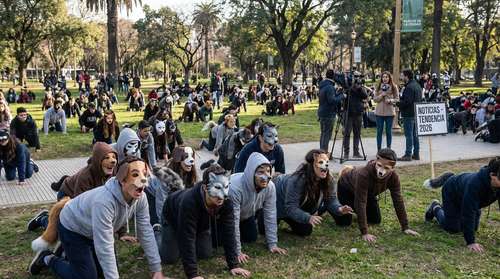
If you walked through the lush plazas of Buenos Aires this past weekend, you might have paused in confusion. Amongst the joggers and dog walkers, a new kind of pack has claimed the turf. They growl, they bark, and they move on all fours with startling agility. They aren’t stray dogs, but Argentina Animal Teens—a viral subculture that has suddenly turned the nation’s public spaces into makeshift wildernesses. As of March 1, 2026, this bizarre phenomenon has captured global attention, blending weird viral news 2026 with a complex debate about identity in the digital age.
The Rise of the 'Animal Teens' in Buenos Aires
The trend, known locally as the 'Therian' movement, has seen teenagers across Argentina gathering in massive numbers to express non-human identities. Unlike traditional furries who wear full mascots, these Animal Teens often wear minimal gear—perhaps a realistic mask or a tail—and focus intensely on mimicking animal behavior, a practice known as 'quadrobics.' On a recent Sunday in a central Buenos Aires park, the scene was surreal. Dozens of youths leaped over park benches, climbed trees with feline grace, and communicated through a series of yips and howls.
Leading one of the most prominent 'packs' is 15-year-old Aguara, a social media influencer who identifies as a Belgian Malinois. With over 125,000 followers on TikTok, Aguara has become the de facto face of these Buenos Aires park trends. "I wake up like a normal person and live my life like a normal person," Aguara told reporters, adjusting her mask. "I simply have moments when I like being a dog." Her sentiment echoes through the crowd, where teens disconnect from the pressures of modern adolescence to reconnect with a primal instinct.
Inside the Pack: Identity or Roleplay?
The phenomenon is often confused with the Otherkin movement, but participants argue there are distinct nuances. While some claim a spiritual connection to their 'theriotype' (their inner animal), others participate for the athletic challenge or community aspect. Aru, a 16-year-old emerging as a voice for the 'Otherpaw' branch of the community, wore a seal mask to the latest gathering. She clarified that for many, it isn't about believing they are literally animals, but rather a form of deep, symbolic play.
"It's not necessarily about identifying as an animal 24/7," Aru explained, watching a peer dressed as a fox navigate a tree branch. "It’s about freedom." This desire for liberation appears to be driving the human animal identity trend deeper into the mainstream. Argentina, with its culturally expressive atmosphere, has become the unexpected epicenter for this movement, leading engagement across all of Latin America.
A Viral Phenomenon: From TikTok to the Trees
The explosion of this viral teen subculture is inextricably checking the pulse of social media. The hashtag #therian has surpassed 2 million posts on TikTok, with Argentine creators dominating the feed. Videos of teens performing high jumps on all fours or 'hunting' in packs gather millions of views, fueling strange world news headlines worldwide. However, the transition from online aesthetic to physical takeover has sparked friction. Passersby range from amused to hostile, with some locals complaining about the noise and the commandeering of public equipment.
The Psychological Perspective
As parents watch their children trade smartphones for snarls, mental health professionals are weighing in. Débora Pedace, a prominent psychologist in Buenos Aires, urges the public to view the trend with nuance rather than panic. "From a psychological standpoint, this is a symbolic identification with an animal," Pedace noted in a recent interview. She warns that while the behavior is generally harmless exploration, it can become concerning if the boundary between human reality and animal persona dissolves completely. For now, however, the parks of Buenos Aires belong to the pack, and the world is watching with a mix of fascination and bewilderment.