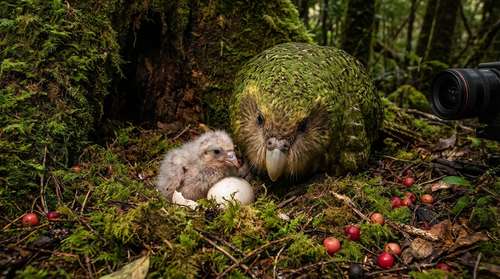
In a heartwarming and slightly bizarre twist to weird world news 2026, the internet has a new obsession: a fuzzy, flightless parrot chick born in an underground bunker. On Tuesday, February 24, 2026, thousands of viewers worldwide tuned into a grainy livestream to witness the miracle of a kakapo nest cam hatching. This rare event marks the peak of a flightless parrot romance season that has captivated social media, all thanks to a massive, berry-fueled aphrodisiac explosion in the forests of New Zealand.
The Rimu Berry 'Love Potion' Fueling the 2026 Boom
Why is the world suddenly obsessed with the sex life of a bird that looks like an owl and walks like a duck? The answer lies in the rimu tree. The kakapo breeding season 2026 is officially a record-breaker, triggered by a "mast year"—a rare botanical event where rimu trees produce a bumper crop of super-nutritious berries. These berries are essentially the only thing that puts the kakapo in the mood for love.
For the past four years, the birds have been largely celibate, waiting for this specific harvest. But 2026 delivered a "mega-mast," carpeting the forest floor with the fruit necessary to raise healthy chicks. Conservationists describe it as a natural fertility boost that has sent the male kakapo into a frenzy of strange bird mating calls. Known as "booming," these deep, resonant sounds can travel for miles, sounding more like a techno bass drop than a bird song, signaling to females that the berry buffet is open.
Viral Underground Birth: The World Watches
The star of this reality show is Rakiura, a female kakapo whose underground nest on Whenua Hou (Codfish Island) has been livestreamed to a global audience. Fans who have spent weeks deciphering the birds' booming rituals were rewarded on Tuesday when Rakiura's latest chick officially broke out of its shell. The kakapo nest cam hatching moment went viral instantly, with viewers celebrating the arrival of the clumsy, white-fluffed newborn.
"It’s better than any drama on Netflix," one fan tweeted, capturing the sentiment of a community that calls themselves "kakapo heads." The camera captures the intimate, often comical reality of kakapo motherhood, from the mother's awkward waddle to her gentle preening of the chick. This level of access is unprecedented, turning a conservation project for New Zealand rare animals into a pop-culture phenomenon.
Why This Hatching Matters
Every chick is a victory. The kakapo population, once decimated to just 51 individuals in the 1990s, has slowly climbed to over 250. This hatching isn't just cute content; it's a critical step away from extinction for a species that has forgotten how to fly and has no natural defense mechanism other than freezing in place—a trait that famously made them "too delicious" to predators introduced by humans.
Meet the 'World's Weirdest Bird'
To understand the hype, you have to understand the bird. The kakapo holds the title of the world's weirdest bird for good reason. It is the world's only flightless parrot, the world's heaviest parrot, and possibly the longest-lived, with some individuals reaching 90 years of age. They are nocturnal, smell like musk and honey, and have a face that looks distinctly like a confused owl.
Their evolutionary strategy is equally baffling. Instead of defending territory, males dig