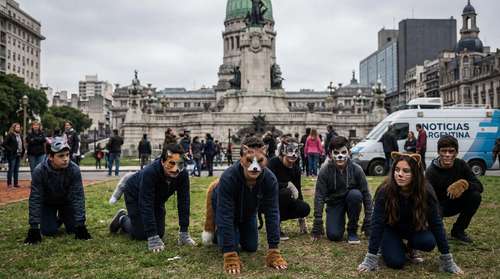
On a sun-drenched Sunday afternoon in late February 2026, a public square in Buenos Aires transformed into something resembling a National Geographic documentary—only the wildlife wore jeans and sneakers. In the middle of the grassy park, a 15-year-old girl named Sofía, donning a hyper-realistic beagle mask, sprinted across the turf on all fours with startling agility. Nearby, another teen named Aguara leaped over a makeshift obstacle course, mimicking the precise, muscular mechanics of a Belgian Malinois dog. This wasn't a theater rehearsal or a costume party; it was a meeting of the therian trend Argentina has seen explode in recent weeks, a viral subculture where adolescents identify psychologically or spiritually as non-human animals.
The Buenos Aires Therian Gathering: A Viral Phenomenon
The scene on February 22 at the Buenos Aires plaza was a vivid illustration of a digital subculture breaking into the physical world. Dozens of teenagers gathered to engage in "quadrobics"—an athletic practice involving running, jumping, and moving on four limbs to emulate animal locomotion. While curious onlookers filmed with their phones, participants like Aguara, who leads a local "pack" and boasts over 125,000 followers on TikTok, directed the group's activities.
For these teens, this is far more than a game. Aguara, who calculates her age as two years and two months in "dog years," explained to local reporters that while she lives a normal human life, she experiences distinct shifts where she feels undeniably canine. "I simply have moments when I like being a dog," she stated, capturing the essence of the human animal behavior phenomenon that is baffling older generations.
Understanding the Pack: Spiritual Identity vs. 'Otherpaw'
To the uninitiated, the sight of teens wearing fox masks and tails might look like "furry" fandom, but members of this community are quick to draw a sharp distinction. While furries create and roleplay anthropogenic characters, a therian human believes they are an animal on an internal, integral level. This belief is known as their "theriotype." However, the movement is not a monolith.
The 'Otherpaw' Distinction
Not every teen running on all fours in the plaza claims a spiritual connection to a wolf or cat. Aru, a 16-year-old attendee wearing a seal mask, described herself as part of the "otherpaw" branch. For her, the masks and movements are a form of creative expression and fun rather than a deep identity crisis. "It's not necessarily about identifying as an animal," she noted, suggesting that the viral animal mask trend 2026 has become a broad umbrella for various forms of teenage self-expression.
Psychologists Weigh In: Identity Crisis or Harmless Play?
As the hashtag #therian surpasses 2 million posts on Argentine TikTok, mental health experts are stepping in to analyze the surge. Parents are asking if teens identifying as animals is a sign of mental illness or just the latest iteration of adolescent rebellion. Débora Pedace, a prominent psychologist and director of the Integral Therapeutic Center in Buenos Aires, urges the public to look past the shock value.
"From a psychological standpoint, this is a symbolic identification with an animal," Pedace explained in a recent interview. She argues that the behavior becomes pathological only if it leads to self-harm or a complete detachment from reality. For most, the pack offers a vital sense of community and belonging—a safe harbor in the often turbulent waters of modern adolescence. In a country known for its "fairly free" social environment, Argentina has become a fertile ground for these niche identities to flourish openly.
A Global Weird World News Moment
The explosion of the therian trend Argentina is shaping up to be one of the definitive weird world news February 2026 stories. The imagery of teens climbing trees and barking in major metropolitan parks has captivated the global internet, drawing reactions ranging from bewilderment to outrage. Critics on social media decry it as a loss of human dignity, while supporters see it as a harmless escape from the pressures of a digital-first society.
Whether this is a fleeting viral moment or a permanent new subculture remains to be seen. But for now, in the parks of Buenos Aires, the call of the wild is being answered by a generation determined to define their identity on their own terms—even if that means walking on four legs.