
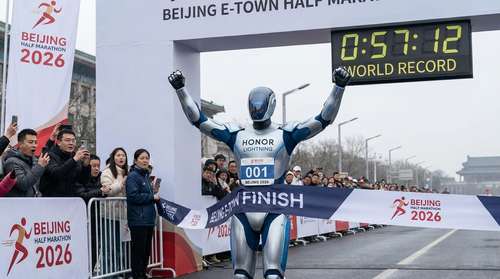
It’s the kind of weird tech news that sounds like a sci-fi movie script, but as of April 19, 2026, it is our new reality. During the second annual Beijing E-Town Half Marathon, a mechanical marvel completely rewrote the rules of competitive racing. In a jaw-dropping display of humanoid sprinting, a machine didn’t just beat the human runners—it absolutely obliterated the fastest human time ever recorded. This unprecedented humanoid robot marathon performance marks a turning point in the rapidly escalating world of AI vs human sports, proving that the robot uprising might just happen on a running track.
The champion of the day was "Lightning," a cutting-edge bipedal machine developed by the Chinese smartphone giant Honor. Running on a parallel track next to 12,000 living, breathing athletes, the crimson-colored robot secured the ultimate robot athlete victory, leaving exhausted humans in the dust and reshaping our understanding of robotic athleticism.
Shattering the Robot World Record—and the Human One
To understand the sheer magnitude of this robot world record, you have to look at the numbers. Lightning completed the 13.1-mile (21.1-kilometer) course in an unbelievable 50 minutes and 26 seconds. For context, the reigning human world record holder, Uganda’s Jacob Kiplimo, ran the exact same distance in 57 minutes and 20 seconds just last month in Lisbon.
That means a machine beat the pinnacle of human athletic achievement by nearly seven full minutes. Spectators watching the Beijing half marathon 2026 were left stunned as humanoids flew over the finish line, completely unfazed and sweat-free. While professional human athletes collapsed into thermal foil blankets, catching their breath after pushing their biological limits, the leading robots stood tall and unscathed. It was a stark, visual representation of a new technological era.
A Staggering Year-Over-Year Leap
What makes Lightning’s finish time even more jarring is the accelerated timeline of robotic development. Just one year ago, at the inaugural 2025 event, the winning robot—a model named Tiangong Ultra—stumbled across the finish line in 2 hours, 40 minutes, and 42 seconds. That time was more than double the pace of the human winner. In exactly 12 months, engineers shaved nearly two hours off the top robotic pace, a developmental leap that took humans decades of nutritional and biomechanical advancements to achieve.
The Tech Behind the Humanoid Sprinting Victory
How exactly did Honor engineer a machine capable of maintaining a blazing sub-four-minute mile pace for over 13 miles? The secret lies in a fascinating crossover between mobile technology and advanced physical engineering. Du Xiaodi, a test development engineer for the winning team, revealed that Lightning had been in rigorous development for a full year, specifically modeled after elite human endurance runners.
The robot is outfitted with 37-inch (95 cm) legs designed to mimic the exact stride length and biomechanics of top-tier marathoners. However, running at such intense speeds generates massive amounts of kinetic friction and heat, which is where the company's smartphone expertise came into play. Lightning is equipped with a highly advanced, in-house liquid-cooling system adapted directly from consumer electronics. This allowed the machine’s internal joints and motors to remain at optimal temperatures without overheating or seizing up during the grueling 50-minute sprint.
Autonomous Navigation and the Future of AI vs Human Sports
This event wasn’t just a remote-controlled toy race. Out of the more than 300 robots representing over 100 different teams, roughly 40 percent navigated the tough terrain completely autonomously. Lightning and its two runner-up stablemates—who swept the podium for Honor—all relied on self-navigation algorithms to trace the course, avoid barriers, and dynamically optimize their pacing.
Not every robot competitor had a flawless Sunday morning, though. The competition wasn't without its technical hiccups—one robot famously fell flat at the starting line, while another veered off course and bumped into a track barrier. But these minor failures only underscored the brilliance of the autonomous machines that successfully navigated the entire course.
Local spectators described the scene as both awe-inspiring and slightly chilling. There is something profoundly unusual about cheering for a runner that doesn't breathe, fatigue, or feel the thrill of competition. Yet, as the machines blitzed past the grandstands, the crowd couldn't help but roar in appreciation of the sheer engineering marvel.
Beyond the Finish Line
While the visual of a robot sprinting down a dedicated track might seem like a bizarre novelty, the real-world implications stretch far beyond entertainment. The structural reliability, advanced liquid-cooling mechanisms, and autonomous processing power required to survive a half-marathon will soon transition into heavy industry, manufacturing, and search-and-rescue operations.
As the dust settles on the 2026 Beijing E-Town event, one thing is abundantly clear: the boundary between biological limits and mechanical potential has been permanently breached. Human athletes will always have the heart and spirit of the race, but when it comes to raw, unyielding speed, our new mechanical counterparts have officially taken the gold.