NEW YORK — In a scene that would have been unimaginable just days ago, former Venezuelan President Nicolás Maduro stood before a federal judge in Manhattan on Monday, pleading not guilty to charges of leading a sprawling narco-terrorism conspiracy. The historic arraignment comes less than 72 hours after U.S. Special Forces launched Operation Absolute Resolve, a high-stakes extraction mission in Caracas that dismantled the socialist leader's grip on power and brought him to American soil.
A Defiant Stand in Manhattan Federal Court
Dressed in a gray prison-issue jumpsuit rather than his signature tricolor sash, a visibly weary but defiant Maduro appeared in the U.S. District Court for the Southern District of New York (SDNY). The courtroom was packed with federal agents, international journalists, and heavy security as Judge Alvin K. Hellerstein read the indictment.
When asked for his plea, the 63-year-old Maduro spoke through a Spanish interpreter, his voice echoing in the silent chamber. "I am innocent. I am not guilty," Maduro declared, gripping the defense table. "I am a decent man, and I remain the president of my country. These charges are political tools, not justice."
Alongside him stood his wife, Cilia Flores, who also entered a plea of not guilty. Flores, 69, appeared to be nursing injuries sustained during the raid; her left arm was in a sling, and a bandage covered her temple. Her defense attorney, Barry Pollack, immediately requested a medical evaluation, alleging that the former First Lady suffered a hairline rib fracture during what he characterized as a "violent and illegal abduction" from the Miraflores Palace.
The Charges: 'Cartel of the Suns'
The indictment, originally unsealed in 2020 and superseded this week with new evidence, paints Maduro not as a politician, but as the head of the "Cartel of the Suns" (Cártel de los Soles). Federal prosecutors, led by Assistant U.S. Attorney Amanda Houle, argue that for over two decades, Maduro conspired with the Revolutionary Armed Forces of Colombia (FARC) to flood the United States with cocaine.
"The defendant used his presidential powers to weaponize drug trafficking," Houle told the court. "He turned the Venezuelan state into a criminal enterprise that exported violence and instability to our shores."
Specific Allegations
The charges against Maduro and Flores include:
- Narco-Terrorism Conspiracy: Carrying a mandatory minimum sentence of 20 years and a maximum of life in prison.
- Conspiracy to Import Cocaine: Allegations of shipping thousands of tons of cocaine into the U.S. via air and maritime routes.
- Weapons Possession: Using and carrying machine guns and destructive devices in furtherance of drug trafficking crimes.
Prosecutors claim the conspiracy generated billions of dollars in illicit proceeds, which were laundered through state-owned oil company PDVSA and used to purchase military-grade weaponry. The judge ordered both defendants remanded to custody without bail, citing an extreme flight risk. They were transferred to the Metropolitan Detention Center in Brooklyn under heavy guard.
Operation Absolute Resolve: The Capture
Details are still emerging about the daring raid that led to the couple's arrest. Pentagon officials confirmed that Operation Absolute Resolve was launched in the early hours of Saturday, January 3. U.S. forces, reportedly acting on actionable intelligence regarding Maduro's location at a fortified safe house in the Fuerte Tiuna military complex, executed a precision strike that bypassed much of the loyalist air defenses.
The operation, which lasted less than 90 minutes, resulted in the surrender of Maduro's personal guard. "This was a surgical extraction designed to minimize collateral damage," a Pentagon spokesperson stated during a briefing in Washington. "The objective was to enforce the indictment and bring a fugitive to justice."
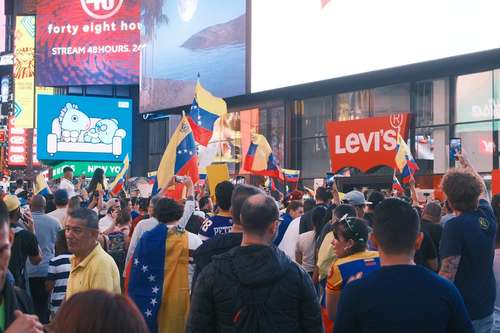
The raid has sent shockwaves through the geopolitical landscape of 2026. While celebrations erupted in parts of Caracas and among the Venezuelan diaspora in Doral, Florida, the move has drawn sharp condemnation from Maduro's remaining allies. Russia and Iran have denounced the operation as a violation of international sovereignty, with Moscow calling for an emergency meeting of the UN Security Council.
Power Vacuum in Caracas
The arrest has left a precarious power vacuum in Venezuela. While the U.S. and its allies have long recognized opposition figures as legitimate authorities, the reality on the ground remains volatile. Following Maduro's extraction, Vice President Delcy Rodríguez—who is also under U.S. sanctions—was swiftly sworn in as interim president by loyalist factions of the National Assembly.
"We will not kneel before imperialist aggression," Rodríguez announced in a televised address on Sunday, surrounded by high-ranking generals. However, reports from Caracas suggest significant fracturing within the military. Several mid-level commanders have reportedly defected or gone into hiding, unsure of their future as the U.S. signals that further indictments could follow.
For the Biden-Harris administration, or the successor government in charge, the challenge now shifts from a military operation to a diplomatic tightrope. The goal is to prevent a civil war while steering the nation toward free elections—a promise that has remained unfulfilled for over a decade.
What Comes Next?
Legal experts predict a protracted battle in the Southern District of New York. Maduro's defense team is expected to file motions challenging the legality of his arrest, citing "head of state immunity" and international law governing extraterritorial operations. "This case will be the trial of the century," said legal analyst and former prosecutor Elie Honig. "You are going to see novel arguments about jurisdiction that haven't been tested since the trial of Manuel Noriega."
Judge Hellerstein has set the next status conference for mid-March, giving both sides time to prepare for the massive discovery process involving terabytes of classified intelligence.
For now, Nicolás Maduro sits in a Brooklyn cell, a stark contrast to the opulence of the Miraflores Palace. As the world watches, the trial promises to expose the inner workings of a regime that crumbled under the weight of its own corruption and the relentless reach of U.S. justice.