
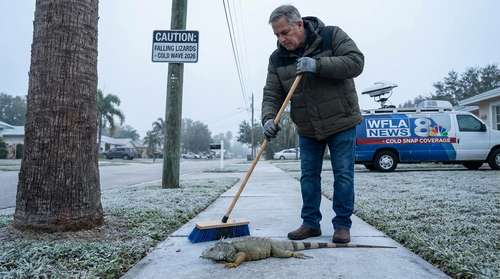
If you live in South Florida, you might want to watch your head today. A historic cold snap gripping the Sunshine State has triggered a chaotic and uniquely Floridian phenomenon: a Lizard Blizzard. As temperatures plunged into the 30s this week, residents from Miami to Vero Beach woke up to a surreal sight—catatonic green iguanas raining from trees and littering sidewalks, driveways, and pool decks. With another cold front forecast for this weekend, the falling iguanas Florida 2026 crisis is far from over.
The Science Behind the 'Lizard Blizzard'
While the image of reptiles plummeting from palm trees sounds like a scene from a B-movie, the biology behind it is straightforward. Green iguanas are cold-blooded invasive reptiles that thrive in Florida's typically balmy climate. However, they have a critical weakness: they cannot regulate their own body temperature. When the mercury drops below 50 degrees Fahrenheit, they become sluggish. Once it hits the 40s and 30s—as it did during this week’s Florida cold snap weird news event—their bodies shut down completely to conserve energy.
Ron Magill, Communications Director at Zoo Miami, explains that these animals enter a state called torpor. "They lose muscle control and literally just let go of the branches," Magill says. "They aren't dead; they are essentially frozen in time until their bodies warm up." This temporary paralysis leads to the infamous frozen lizards Miami residents are currently dodging on their morning commutes.
Frozen Iguana Cleanup: A Booming Business
For homeowners, the novelty of a lizard blizzard quickly wears off when they realize the mess left behind. Falling iguanas can weigh up to 15 pounds, capable of denting cars and cracking patio tiles. As a result, the demand for iguana cleanup service providers has skyrocketed in the last 48 hours. Jessica Kilgore, owner of Iguana Solutions, reports that her crews have collected hundreds of kilograms of comatose reptiles since Tuesday.
"My phone hasn't stopped ringing," Kilgore told local reporters. "People are finding them everywhere—floating in pools, piled up on roofs, and blocking garage doors. We're working 12-hour shifts just to clear the backyards." The cost for professional removal can range from $200 for a single visit to over $2,000 for large property infestations, a price many are willing to pay to avoid dealing with the thawing reptiles themselves.
The 'Florida Man' Twist: Iguana Pizza?
In true weird local news USA fashion, some Floridians are making lemonade—or rather, pizza—out of lemons. Reports have surfaced of a local trapper, Ryan Izquierdo, teaming up with a North Palm Beach pizzeria to create the "Florida Man Pizza," topped with freshly harvested iguana meat. While not for the faint of heart, the stunt highlights the abundance of the invasive species during this freeze. State officials, however, remind the public that while hunting iguanas is legal on private property, it must be done humanely.
Official Warning: Don't Rescue the Reptiles
Despite their pitiful appearance, officials have issued a stern frozen iguana warning: do not bring these animals into your home to warm them up. The Florida Fish and Wildlife Conservation Commission (FWC) has been flooded with calls from well-meaning residents who rescued "dead" lizards, only to have them thaw out and go berserk inside their living rooms.
"These are wild animals with sharp claws and teeth," warns the FWC. "Once they defrost, they feel threatened and will defend themselves aggressively." Instead of a DIY rescue, the FWC issued Executive Order 26-03 this week, temporarily facilitating the collection of over 5,000 cold-stunned iguanas to manage the invasive population. If you find a frozen iguana, the best advice is to leave it alone or call a professional. As the forecast predicts another dip in temperatures for Friday morning, keep an eye on the sky—it might be raining reptiles for a few more days.