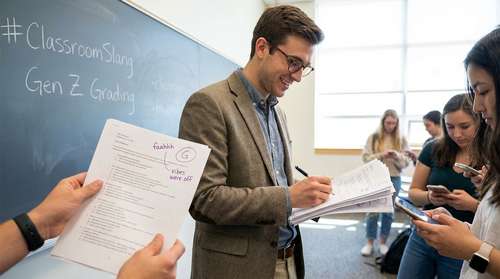
The days of receiving a test paper covered in intimidating red ink are officially over. As we navigate the educational landscape of April 2026, a new era of academic feedback has arrived, fully equipped with modern digital vocabulary. A Gen Z professor has taken the internet by storm after a video surfaced showing them evaluating university exam papers using contemporary classroom slang like 'Faahhh,' 'LOL,' and 'vibes were off'. This hilarious shift in grading culture has captivated millions, rapidly becoming one of the most talked-about pieces of TikTok viral news this week.
The TikTok Viral News That Broke the Internet
The incident that sparked this massive online conversation originated from a social media clip shared by content creator Kartikey Tiwari. The video provides a behind-the-scenes look at his nephew, who recently secured a position as a chemical engineering professor, powering through a stack of complex midterm papers. Instead of writing standard academic critiques like 'Please review your formulas' or 'See me after class,' the young educator opted to drop some brutal honesty wrapped in the language of the internet.
With a text overlay proudly declaring that 'Gen Z professors got no chill,' the clip showcased exactly what a modern savage evaluation looks like. The narrator playfully warned his audience that the younger generation probably shouldn't be allowed to become professors because their feedback is entirely unfiltered. Watching a high-level engineering equation get shot down with a simple 'Faahhh' or 'LOL' is rapidly cementing itself as one of the ultimate funny teacher moments of the year.
Chemical Engineering Meets Digital Culture
What makes this specific instance so compelling is the stark contrast between the subject matter and the feedback. Chemical engineering is notoriously rigorous, demanding absolute precision. Seeing a highly technical, multi-step calculation dismissed because the 'vibes were off' highlights a hilarious clash of worlds. The professor wasn't just giving up on the grading process; they were accurately pinpointing that the student's underlying logic was fundamentally misaligned, just communicating it through the lens of modern classroom slang.
From Red Ink to 'Vibes Were Off': Classroom Slang Takes Over
Getting a terrible grade usually triggers a wave of panic and academic dread. However, the internet largely agrees that this unconventional method significantly softens the blow. For university students accustomed to anxiety-inducing feedback, seeing an internet acronym scribbled next to an incorrect answer is surprisingly refreshing. It strips away the intimidating aura of higher education and brings a desperately needed level of humanity to the classroom.
This viral exam grading incident highlights a massive shift in how educators connect with their student body. Traditionalists might argue that university-level exams require a strictly formal tone to maintain institutional prestige. Yet, younger educators are quickly realizing that meeting students on their level yields far better engagement. When feedback feels like a text message from a friend rather than a reprimand from an authority figure, students are often more receptive to correcting their mistakes.
Changing Gen Z Workplace Trends in Academia
This story is much more than just a fleeting piece of LOL news today; it perfectly illustrates broader Gen Z workplace trends. As the generation raised on smartphones and rapid-fire social media enters the professional workforce, they are bringing their authentic communication styles directly into the office and the lecture hall. The rigid boundary between professional terminology and everyday speech is rapidly dissolving.
We are watching an entire demographic rewrite the rules of corporate and academic culture. This viral moment proves that you can hold a serious, highly intellectual job while maintaining your personal voice. The younger workforce prioritizes transparency and directness over outdated formalities, fundamentally altering how professional feedback is delivered across all industries.
Moreover, these changing dynamics indicate a shift in how authority is perceived. Older generations often equated professionalism with emotional distance and rigid vocabulary. In contrast, today's young professionals build respect through relatability and transparent communication. By utilizing phrases their students actively use, this engineering professor dismantled the traditional hierarchy of the classroom, replacing it with a peer-to-peer mentorship model that resonates deeply with modern learners.
The Internet's Verdict on the Savage Evaluation
Social media users immediately flooded the comment sections across multiple platforms, sharing a mix of admiration, nostalgia, and absolute disbelief. Countless current students expressed that a savage, slang-filled critique would honestly hurt a lot less than a formal academic failure. As one user accurately pointed out, 'Put Gen Z in any role... the directness stays the same'.
Many older commentators lamented that they graduated too early to experience this kind of relatable mentorship. Having an instructor who understands digital humor translates to a less intimidating, more collaborative dynamic. While a few staunch traditionalists debated whether phrases like 'no cap' belong on a chemical engineering final, the overwhelming consensus is that this unfiltered authenticity is exactly what higher education needs right now.
The phenomenon has also sparked larger discussions about educational reform. As attention spans shift due to short-form media, educators are constantly looking for innovative ways to capture student interest. While dropping a meme or a slang term on an exam sheet might seem trivial, it represents a crucial adaptation strategy. It shows that teachers are willing to evolve, ensuring that the classroom remains a dynamic and relevant environment rather than a stagnant institution.
Ultimately, the viral clip proves that the evolution of teaching is moving in a highly entertaining direction. The future of academia is clearly in good hands—even if those hands are actively diagnosing your failed exam as having terrible vibes.