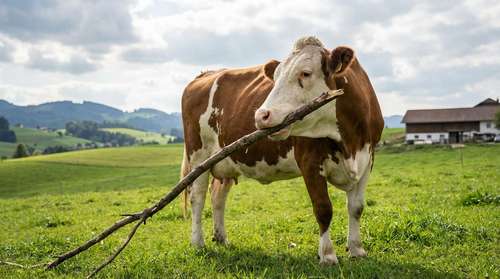
Move over, primates—there's a new genius in the animal kingdom, and she moos. In a groundbreaking discovery that is turning the scientific world upside down, researchers in Austria have documented the first-ever case of a cow using tools to solve a problem. Veronika the cow, a 13-year-old Swiss Brown living in the idyllic pastures of Carinthia, has been caught on camera using sticks and brooms to scratch hard-to-reach itches on her back. This remarkable behavior, detailed in a study published this week in the journal Current Biology, suggests that animal intelligence 2026 is far more complex than we ever imagined.
The Discovery: A Bovine Einstein in Austria
The story of Veronika began not in a laboratory, but in the lush, green meadows of Nötsch im Gailtal, Austria. Witgar Wiegele, an organic farmer and baker who keeps Veronika as a beloved pet rather than livestock, first noticed her peculiar habit over a decade ago. Unlike typical cattle that rub against trees or fence posts, Veronika would pick up fallen branches with her mouth and maneuver them to scratch specific spots on her body.
"She was a bit clumsy at first," Wiegele reportedly noted, but over time, her technique became surprisingly sophisticated. Recognizing the uniqueness of his bovine companion, Wiegele captured video footage of her behavior. When this footage reached Dr. Alice Auersperg and Dr. Antonio Osuna-Mascaró at the University of Veterinary Medicine in Vienna, they immediately knew they were witnessing something extraordinary. "It was immediately clear that this was not accidental," Auersperg stated. The team packed their gear and headed to the Austrian countryside to verify this unprecedented instance of a smart cow scratches back.
The Science: Multi-Purpose Tool Use Confirmed
To rigorously test Veronika's abilities, the researchers conducted a series of controlled experiments. They presented her with a deck brush—a tool with two distinct ends: a bristled head and a smooth wooden handle. The results, published on January 19, 2026, in Current Biology, were stunning. Veronika didn't just randomly flail the object; she demonstrated what scientists call "flexible, multi-purpose tool use."
When Veronika needed to scratch her tough, thick-skinned back, she manipulated the brush to use the bristled end, applying vigorous pressure. However, when the itch was on her sensitive belly or udder, she flipped the tool to use the smooth wooden handle, scratching with gentle precision. This ability to select the right part of a tool for a specific task—and to adjust the technique based on the body part—is a cognitive feat previously thought to be the exclusive domain of humans and advanced primates like chimpanzees.
Breaking the "Cow Tools" Stereotype
For decades, the idea of cow using tools was the stuff of comedy, most notably immortalized in Gary Larson's famous "Cow Tools" cartoon, which depicted a bovine standing next to crude, nonsensical objects. Veronika has effectively debunked this stereotype. "Perhaps the real absurdity lies not in imagining a tool-using cow, but in assuming such a thing could never exist," the researchers wrote in their study. This bovine innovation study proves that cattle possess the mental hardware for complex problem-solving, provided they have the opportunity to develop it.
Rethinking Livestock Intelligence
The implications of this discovery extend far beyond one clever cow. It forces a significant reassessment of livestock cognition. Dr. Osuna-Mascaró emphasized that this behavior is classified as "egocentric tool use" because the tool is applied to the animal's own body. While often considered simpler than using tools to affect the environment (like a chimp fishing for termites), Veronika's case is unique because of the physical constraints she overcomes. Lacking hands, she must manipulate the tool entirely with her mouth and tongue, requiring immense coordination and planning.
"What this tells us is that cows have the potential to innovate tool use, and we have ignored this fact for thousands of years," Osuna-Mascaró explained. With over 1.5 billion cattle globally, the fact that this is the first documented case highlights a massive blind spot in animal behavior science. It suggests that many farm animals may possess latent cognitive abilities that go unnoticed in industrial farming environments, where they lack the freedom, objects, and lifespan to explore their potential.
Why Veronika? The Perfect Storm for Innovation
You might be wondering: if cows are this smart, why haven't we seen this before? The answer likely lies in Veronika's unique lifestyle. As a pet who is not raised for meat or dairy production, she has lived a long life—13 years and counting—in a stimulating environment full of interaction and loose objects. Most commercial cattle are processed long before they reach this age and live in restrictive settings that stifle curiosity.
Veronika's