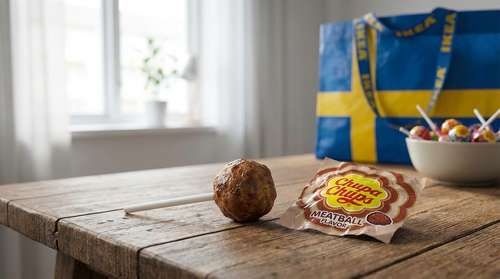
If you logged onto social media this morning, you likely experienced a mix of sheer horror and undeniable curiosity. For the highly anticipated Chupa Chups April Fools 2026 celebration, the legendary lollipop brand joined forces with furniture giant IKEA to unveil the ultimate head-scratcher: the IKEA meatball lollipop. Billed as the perfect intersection of sweet and savory, this prank product immediately sent shockwaves across digital platforms, proving that our appetite for bizarre internet moments remains insatiable.
The concept is simple yet staggering. Imagine the iconic, savory flavor profile of a classic Swedish meatball, shrunk down to pocket size, impaled on a familiar white plastic stick, and finished off with a tangy lingonberry twist. It is precisely the kind of chaos you expect from viral brand pranks, but the visual execution was so flawless that thousands of users initially believed they could grab one on their next Sunday furniture run.
No Allen Key Needed: Inside the Swedish Meatball Candy
Ingka Group, the largest IKEA retailer, pulled out all the stops to make this Swedish meatball candy feel astonishingly real. Press materials touted the snack as a daring "world-first" innovation designed for adventurous eaters who want their fix on the go, completely eliminating the need for a cafeteria tray or cutlery. Staying true to the company's flat-pack DNA, the marketing proudly highlighted one specific, hilarious perk: "no assembly required".
Javier Quiñones, Commercial Manager at Ingka Group, played along perfectly in the mock announcement. He noted that the collaboration demonstrated how creativity and customer insight drive the company's decisions. The prank was even backed up by legitimate consumer data from an IKEA study claiming that 46% of people admit to having a major sweet tooth. By reimagining a beloved cafeteria staple as a light-hearted, boundary-pushing treat, IKEA successfully captured the cultural zeitgeist of weird world trends.
When Bizarre Food Meets Genuine Demand
While the meatball-on-a-stick was clearly an elaborate gag, the public's reaction quickly flipped the script. Internal mock-testing quotes released by IKEA included playful employee feedback like, "My tongue is confused, but my heart is happy," and "It's strangely wonderful". Surprisingly, social media users fiercely agreed with these fictional taste testers.
Rather than pure disgust, an overwhelming wave of online comments actually demanded that the company manufacture the strange confection. What started as a funny entry into IKEA food news 2026 rapidly transformed into a fascinating case study on modern consumer desires. Shoppers are exhausted by standard snack aisles and actively seek out novelty. The boundary between a comedic "WTF" reaction and a genuine craving has never been thinner, meaning major retailers can test the waters for eccentric product lines without risking their reputation.
The Golden Age of Weird Food Collaborations
The IKEA and Chupa Chups alliance was not the only culinary stunt to dominate the news cycle today. The corporate landscape was packed with weird food collaborations that blurred the line between genius and absolute madness.
- The Choccybel: Cheese snack favorite Babybel teamed up with Monty Bojangles to unveil a peelable cheese wheel covered in a cocoa-dusted chocolate truffle shell, supposedly developed over 18 months by dedicated "peel engineers".
- Candy Floss Pizza: Italian restaurant chain Zizzi claimed to be testing a pizza topped with melting candy floss to sweeten their classic tomato base.
- Tinned Hawaiian Pizza: Dole fruit company jokingly released a canned version of the highly controversial pineapple pizza, creating an immediate uproar among traditionalists.
Beyond the culinary sphere, retail and travel sectors eagerly joined the frenzy. Asda jokingly revealed adult-sized trolley seats resembling reclining armchairs to combat "shopping chaos" after claiming 73% of shoppers lose their companions mid-aisle. Meanwhile, Swiss International Air Lines announced "Fit all the way" long-haul seats equipped with bicycle pedals, promising cheaper tickets for passengers who physically pedaled to power the plane during their flights.
Why We Constantly Fall for These Stunts
As we navigate another year of elaborate corporate practical jokes, it becomes increasingly clear why companies invest so much time and money into April 1st. A successful stunt generates massive organic reach, bypassing traditional advertising algorithms and expensive media buys. By tapping into the inherent absurdity of internet culture, a well-executed prank builds immense brand affinity. When a massive multinational corporation shows it does not take itself too seriously, everyday consumers feel a stronger, more personal connection to the brand.
There is also a hidden layer of brilliant market research happening beneath the laughter. If the public outcry for the meatball lollipop is strong enough, there is no stopping it from manifesting as a limited-edition promotional item in the future. Brands have turned fictional jokes into real consumer goods before. For now, however, we will have to settle for the traditional plate of meatballs at the food court. But today proved one undeniable fact: if you put a Swedish meatball on a stick, the internet will happily eat it up.