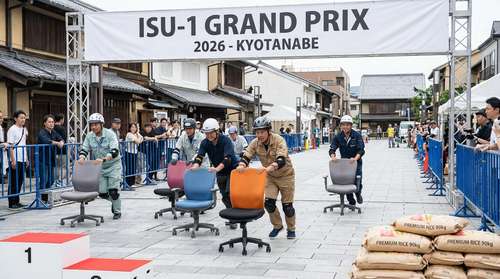
Forget Formula 1 and the 24 Hours of Le Mans. Just days ago, on March 29, 2026, the quiet streets of a Kyoto Prefecture municipality transformed into a high-stakes battleground for one of the most physically demanding—and visually absurd—competitions on the planet. Welcome to the ultimate Japan office chair race, officially known as the ISU-1 Grand Prix 2026. Here, standard workplace furniture is pushed to its absolute limits, and corporate salarymen swap their tailored suits for heavy-duty crash helmets.
At first glance, the event looks like a spontaneous prank pulled by bored office workers. But a closer look reveals a highly coordinated, intensely competitive endurance sport. Dozens of three-person teams gathered at the starting line, awaiting the signal to kick off a brutal two-hour war of attrition. This is not just a quirky local festival; it has evolved into a centerpiece of funny world news, capturing international attention for its bizarre blend of elite athleticism and office supplies.
The Brutal Reality of Kyotanabe Office Chair Racing
Kyotanabe office chair racing operates under a surprisingly strict set of rules. Teams must rely entirely on store-bought, unmodified rolling chairs. No custom bearings, no motorized enhancements, and absolutely no steering mechanisms. The racers propel themselves backward through a designated street circuit, using only the sheer explosive power of their legs. Because the asphalt is unforgiving, organizers mandate comprehensive safety gear, including helmets, thick gloves, elbow pads, and knee guards.
Calling this an office chair endurance contest is almost an understatement. The physical toll on the participants is immense. According to veteran racers, a winning team will cover anywhere from 20 to 25 kilometers during the 120-minute time limit. That requires each team member to vigorously backward-pedal for nearly eight kilometers. It is a brutal test of stamina that leaves thighs burning and lungs gasping for air. The equipment suffers just as much as the humans. Throughout the race, the distinct clatter of polyurethane wheels on pavement is frequently interrupted by the sharp crack of breaking plastic. Casters snap, backrests collapse, and competitors are regularly sent tumbling onto the road as their chosen steeds disintegrate beneath them.
Fighting for the Ultimate Prize: 90 Kilograms of Rice
You might expect the victors of such a grueling physical trial to walk away with a massive cash prize or a multi-million-dollar sponsorship deal. Instead, the podium finishers at the ISU-1 Grand Prix are rewarded with something much more culturally resonant and highly practical. The championship squad takes home a staggering 90 kilograms of premium local rice.
The second-place team earns 60 kilograms, while the third-place finishers haul away 30 kilograms. This massive carbohydrate payload is purposely chosen because it is a staple of the Japanese diet and incredibly easy to distribute among the three teammates, their families, and their supportive pit crews. It turns the winner's podium into a highly competitive grocery run, stripping away the commercialism of modern sports and keeping the event wonderfully grounded.
The Mastermind Behind the Madness
The genesis of this wildly popular event traces back to a very relatable childhood experience. The race was founded by Tsuyoshi Tahara, who spent his younger years being constantly scolded by teachers for playing and rolling around on his classroom chairs. Rather than outgrowing the habit, Tahara weaponized it. He launched the first official race in 2010 with the initial goal of revitalizing a struggling local shopping arcade.
What began as a grassroots effort quickly ballooned into a nationwide sensation. Today, the competition features regional qualifiers and operates in more than 20 locations across the country, from Tokyo to Hokkaido. Tahara has explicitly stated that the race serves a dual purpose. Beyond generating community revenue, it acts as a massive pressure release valve for a population known for its grueling work hours. It allows serious, hard-working adults to regress to childhood for an afternoon, throwing themselves wholeheartedly into something beautifully silly.
The Future of Wacky Japanese Races
While it undeniably ranks high on the list of weird sports Japan has to offer, the sheer competitive drive on display elevates the event above mere parody. Tactics play a major role. Teams meticulously plan their relay changeovers, scout the track for dangerous potholes that might swallow a caster, and select specific chair models based on weight and backrest height. Lighter chairs offer better acceleration, but bulkier ones survive the pavement longer.
As the 2026 season rolls on, the international profile of these wacky Japanese races continues to climb. Tahara has not been shy about his ultimate ambition for the league. His dream is to one day pack up the rolling chairs and take the ISU-1 Grand Prix to Monaco. Until the day corporate furniture hits the iconic hairpins of the French Riviera, fans and participants alike will continue to flock to Kyoto, ready to sacrifice their wheels, their dignity, and their quadriceps for a taste of glory and a massive bag of rice.