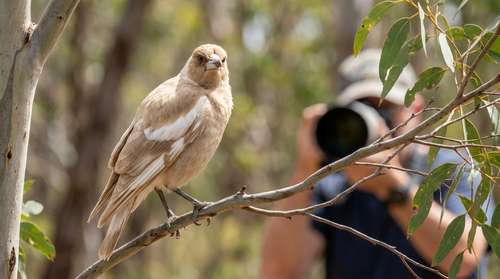
A tiny, cinnamon-colored bird has turned the quiet town of Howlong, New South Wales, into the epicenter of a global viral sensation this week. Dubbed the Latte Magpie by charmed locals, this juvenile Australian magpie has captured the hearts of millions after images of its rare, coffee-hued plumage began circulating on social media just 48 hours ago. Unlike its iconic black-and-white relatives, this unique fledgling sports a soft, milky-brown coat, a striking anomaly that experts are calling a "one-in-a-million" natural wonder.
The Viral Sensation of Howlong
The frenzy began when local resident and avid photographer Judy Lockwood shared a series of high-definition snapshots of the bird on a community Facebook group. The images, taken near the Howlong Golf Resort and the local dog park, show the small bird foraging confidently alongside its standard-colored siblings. Within hours, the post had been shared thousands of times, leaping from local community boards to international headlines as one of the top viral animal stories 2026 has seen so far.
Witnesses describe the bird as the smallest in its clutch—or "mischief," as a group of magpies is collectively known. Despite its stature and unusual coloring, the "Latte Magpie" appears healthy and is reportedly being well-cared for by its parents. "It stands out like a beacon against the green grass," said one local birdwatcher who drove three hours to catch a glimpse. "You usually see them in stark black and white, so seeing this soft brown is almost surreal. It looks like it's been dipped in cappuccino."
The Science Behind the ‘Latte’ Feathers
While the internet is cooing over the bird's aesthetic, ornithologists are fascinated by the genetics at play. The bird's condition is known as leucism in birds, a genetic mutation that differs significantly from albinism. Unlike albino birds, which lack all melanin and have pink eyes, leucistic birds have a partial loss of pigmentation. This results in the "washed-out" or diluted color we see in the Howlong specimen, while allowing the bird to retain its normal dark eye color.
Dr. Sarah Pagonis, an avian geneticist, explains why this rare bird mutation is so special. "Leucism affects the deposition of melanin in the feathers," she notes. "In Australian magpies, it's incredibly rare to see such a uniform cinnamon or 'isabelline' coloration. Often, leucism presents as patchy white spots. To see a bird that is entirely this soft 'latte' shade is a spectacular roll of the genetic dice."
Survival of the Fittest?
The rarity of this rare brown magpie isn't just due to genetics; it's also a matter of survival. Lacking the standard camouflage of their species, leucistic birds are often more visible to predators like hawks and cats. However, locals report that this particular magpie is feisty and well-integrated into its family unit, which offers it protection. Its acceptance by the flock is a good sign for its longevity, suggesting it isn't being ostracized for its difference.
Birdwatching Tourism Booms in Howlong
The sighting has inadvertently put the small town of Howlong on the map for weird world nature news enthusiasts. Local businesses are already reporting an uptick in visitors inquiring about the Howlong Australia bird. "We've had calls from as far as Sydney and Melbourne asking exactly where the bird was last seen," says a receptionist at a nearby motel. "It's becoming a bit of a pilgrimage for birders."
This isn't the first time a brown magpie has made waves—a similar "mischief" near Geelong famously inspired the Brown Magpie Wines label—but the high-definition era of 2026 has allowed this specific fledgling to reach a level of fame its predecessors never did. The Latte Magpie is currently trending across three major social platforms, with users creating fan art and calling for the bird to be named the town's official mascot.
Ethical Birding: A Reminder
As excitement builds, wildlife experts are urging the public to exercise caution. Crowding the bird or trying to bait it with food for the perfect Instagram shot can cause fatal stress to a juvenile animal. "The best way to enjoy this rarity is from a distance with a good zoom lens," warns Dr. Pagonis. "Let's ensure the 'Latte Magpie' grows up to be a strong adult so we can enjoy its beauty for years to come."
For now, the little brown bird continues to hop through the sprinklers of the Howlong golf course, blissfully unaware that it has become the most famous bird on the planet this week.