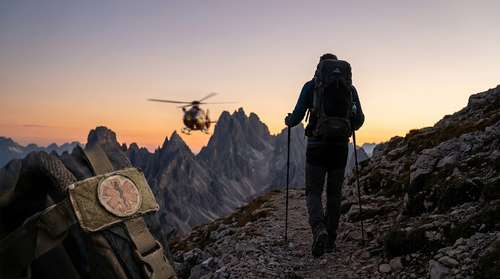
Climbing Montana's highest peak is an arduous task on a good day. It becomes significantly more complicated when you trip and spear yourself through the torso with your own gear. That is exactly what happened to 32-year-old David Cifaldi on July 20, 2026. In a remarkable feat of endurance and stubbornness, this Montana hiker impaled trekking pole survivor simply assessed his own vitals, decided it was a mere scratch, and walked off the mountain.
Instead of panicking, Cifaldi channeled his professional medical experience to orchestrate a staggering Montana nurse self rescue. Facing the reality of a steep medical evacuation fee, he chose a grueling 10-mile hike down treacherous alpine terrain, proving that sometimes the fear of an American healthcare bill is a stronger motivator than a gaping puncture wound.
The Granite Peak Impalement
The adventure began at 2:00 a.m. when Cifaldi and two friends, Jesse Ross and Brad Reich, began their ascent toward Granite Peak. They successfully navigated the ominous Froze-to-Death Plateau by sunrise and pushed toward the 12,800-foot summit. The weather was perfect—sunny, windless, and comfortably in the mid-60s.
At roughly 11,800 feet, Cifaldi lost his footing on loose scree. He tumbled onto the rocks, initially thinking he had just dropped his gear. Rolling over, he realized his 44-inch steel-tipped trekking pole was completely lodged in his body.
The metal rod entered beneath his left armpit, pierced through his lateral muscle, and protruded from his lower back. A full eight inches of the steel pole was visibly sticking out of his exit wound.
When Your "Nurse Brain" Takes Over
A horrific Granite Peak impalement would normally warrant an immediate SOS and a desperate wait for a rescue helicopter. Cifaldi, however, happens to be an emergency room wound care nurse at St. Vincent Regional Hospital in Billings, Montana.
He immediately performed a clinical self-assessment right there on the scree field. The pole was not moving. He was not coughing up blood, and he could take deep, unobstructed breaths. Because the rod had miraculously missed his lungs and major organs, he experienced surprisingly little pain. His friends snapped photos of the entry and exit points so Cifaldi could properly evaluate the damage.
With his medical training taking the wheel, he instructed his friends to leave the pole exactly where it was. Removing an impaled object in the backcountry can trigger catastrophic hemorrhaging. Leaving it in place acts as a plug for the severed blood vessels.
"Tis But A Flesh Wound": Hiker Avoids Helicopter Bill
Once Cifaldi determined he was stable, the trio faced a massive logistical hurdle. Should they wait for an airlift? Cifaldi quickly did the math on what a high-altitude medevac would cost. He looked at his companions and declared they needed to walk down.
His friends were understandably hesitant about letting a man with a spike through his ribcage hike down a mountain. Quoting the iconic Black Knight from Monty Python and the Holy Grail, Cifaldi reassured them: "I'm pretty confident this is outside my chest wall. 'Tis but a flesh wound".
The group used a Garmin inReach satellite device to message Stillwater County Search and Rescue. They clearly outlined their plan: a flesh wound trekking pole injury, stable vitals, and a self-guided descent. Search and rescue commanders monitored their progress via dispatcher, taking updates every 30 minutes while the trio navigated the perilous route.
A Six-Hour Trek to the Trailhead
The descent was anything but a leisurely stroll. The group had to bushwhack down unmarked routes, cross slippery snowfields, and scramble over jagged boulder fields—all while Cifaldi carefully managed a metal rod protruding from his side.
They hiked for six and a half hours, dropping 1,500 meters in elevation over 10 miles. Along the way, Cifaldi remained remarkably calm. At one point near Mystic Lake, he even asked his friends to walk ahead of him to shield young children on the trail from the gruesome sight of his injury.
Reaching the trailhead where Ross had parked their vehicle, the ordeal was still not over. They loaded into the car and drove two hours to the hospital in Billings. Surgeons finally took over, carefully extracting the trekking pole in a controlled operating room.
The Ultimate Funny Local News Legend
Today, this bizarre tale of survival and financial pragmatism is making headlines as an unbelievable piece of funny local news. It highlights a unique blend of extreme mountaineering risk, perfect luck, and sheer grit.
Cifaldi acknowledges how close he came to a very different outcome. "A couple inches the other way and this would be a different story," he told reporters. While his climbing buddies have launched a fundraiser to help cover the inevitable hospital costs and potential future surgeries, dodging the helicopter fee remains a massive win. For outdoor enthusiasts, the story serves as a wild reminder to check your footing, pack a satellite communicator, and perhaps enroll in a few advanced first aid courses before hitting the trail.