February 14, 2026 – For decades, the scientific community has held a somewhat dimmer view of bovine intelligence, often assuming cows were simple grazers with little cognitive complexity. That assumption has just been shattered by a 13-year-old Swiss Brown cow named Veronika. In a groundbreaking discovery that is currently making waves across the world of animal science, researchers in Austria have documented the first consistent case of a cow using tools to scratch an itch—literally. The study, published in Current Biology and the subject of intense discussion this week, reveals that Veronika isn't just thrashing about; she is demonstrating flexible, intentional, and multi-purpose tool use previously thought to be the domain of primates and corvids.
The Discovery That Shook the Barnyard
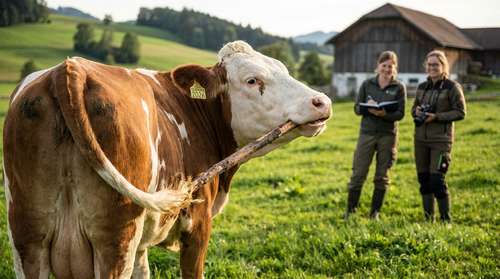
The revelation comes from the idyllic pastures of Nötsch im Gailtal, a village in southern Austria, where Veronika lives as a companion animal. Her owner, organic farmer and baker Witgar Wiegele, had noticed for years that Veronika would pick up sticks, branches, and brushes with her mouth to scratch hard-to-reach spots on her body. While farmers often have anecdotal stories of clever livestock, this behavior caught the attention of cognitive biologists Alice Auersperg and Antonio J. Osuna-Mascaró from the University of Veterinary Medicine, Vienna.
"When I saw the footage, it was immediately clear that this was not accidental," Auersperg noted in a recent interview. The team traveled to Veronika's pasture to conduct controlled experiments, providing her with a deck brush to see if the behavior was a fluke or a sign of genuine cognitive planning. What they found was astonishing: Veronika didn't just use the tool; she manipulated it with precision.
Flexible Tool Use: A Sign of High Intelligence
The core of this discovery lies in the way Veronika uses her tools. According to the study, she demonstrates "flexible, multi-purpose tool use." When she needs to scratch her thick-skinned back, she expertly maneuvers the bristled end of the brush for a vigorous scrub. However, when the itch migrates to more sensitive areas like her udder or belly, she flips the tool to use the smooth wooden handle, applying a gentler touch.
"Veronika is not just using an object to scratch herself," explained Osuna-Mascaró. "She uses different parts of the same tool for different purposes, and she applies different techniques depending on the function of the tool and the body region." This level of discrimination—understanding that one object can have two distinct functions depending on its orientation—is a cognitive leap that challenges everything we thought we knew about farm animals. Until now, such flexible tool use was primarily associated with chimpanzees and humans.
The 'Cow Tools' Connection
The discovery has sparked a viral resurgence of Gary Larson's famous 1982 The Far Side cartoon titled "Cow Tools," which depicted a cow standing proudly next to crude, nonsensical implements. For nearly 45 years, the joke was that cows lacked the intelligence to create meaningful tools. Veronika has effectively turned that punchline on its head. While she may not be forging iron, her ability to select, manipulate, and apply a tool for a specific physiological need proves that the bovine mind is far more capable of innovation than previously credited.
Why This Matters for Animal Science
This week's buzz around the study highlights a critical blind spot in ethology: the "gap in observation." Researchers argue that because cattle have been domesticated for food and labor for 10,000 years, we have rarely looked at them as individuals with distinct personalities or problem-solving skills. Veronika's unique situation—living as a long-term pet with a stimulating environment and trusted human interaction—likely gave her the safety and opportunity to develop these skills.
The study classifies her behavior as "egocentric tool use," meaning the tool is applied to the user's own body rather than the environment (like a chimp fishing for termites). While sometimes considered less complex, the motor control required for a cow to manipulate a long brush with only its mouth and tongue is physically extraordinary. It suggests that if given the chance, other cows might demonstrate similar "genius" traits that go unnoticed in industrial farming settings.
A New Era for Bovine Brains
As news of Veronika's talents continues to spread this February, it invites a re-evaluation of how we treat and understand livestock. "The findings highlight how assumptions about livestock intelligence may reflect gaps in observation rather than genuine cognitive limits," Auersperg summarized. Veronika proves that with the right motivation—in this case, a persistent itch—and the right environment, cows can be surprisingly inventive engineers of their own comfort.