
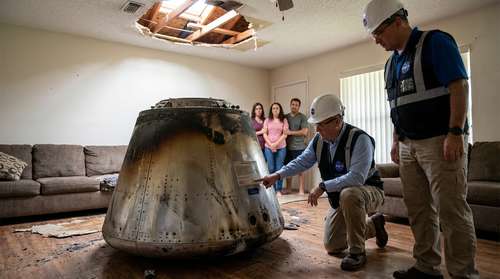
Residents of Naples, Florida, recently found themselves at the center of an extraterrestrial mystery when a metallic cylinder plummeted from the sky, violently crashing through the roof and two floors of a residential property. For weeks, speculation ran rampant about the origin of the bizarre projectile. However, following a rigorous analysis at the Kennedy Space Center, officials have finally broken their silence. The agency officially confirmed yesterday that the unidentified flying object was, in fact, NASA space junk. This startling revelation marks a critical moment for aerospace safety, raising profound questions about what happens when our orbital waste comes dangerously close to home.
The Truth Behind the Florida Home Hit by Space Debris
When the 1.6-pound metal object smashed into the Naples residence last month, it left behind a shattered ceiling and a stunned family. Now, the space agency has provided definitive answers regarding the Florida home hit by space debris, formally identifying the material as NASA space junk. According to their official statement, the debris is a stanchion—a structural support pillar—made from a highly durable superalloy known as Inconel.
Measuring just four inches tall and 1.6 inches wide, this dense piece of metal was part of the flight support equipment used to secure aging nickel-hydride batteries. These batteries were loaded onto a massive cargo pallet and unceremoniously jettisoned from the International Space Station (ISS) in March 2021. While the agency's sophisticated engineering models predicted the entire 5,800-pound payload would safely and completely incinerate during its fiery atmospheric plunge, this resilient stanchion stubbornly survived.
Upgrading the Space Station's Grid
The sequence of events leading to this near-tragedy began years prior during a major power supply upgrade on the orbital laboratory. Astronauts conducted a series of complex spacewalks to replace the station's older, inefficient nickel-hydride batteries with cutting-edge lithium-ion units. The obsolete equipment was then packed onto a disposable pallet and set adrift. For nearly three years, this 2.6-ton package of space refuse slowly spiraled toward Earth, dragged downward by the faint whispers of our upper atmosphere. Specialists confidently assured the public that the immense heat of re-entry would vaporize the entire load. This incident has now exposed critical blind spots in current atmospheric heating simulations.
A Terrifying ISS Hardware Crash
The reality of an ISS hardware crash hitting a civilian structure is a scenario that experts have long hoped to avoid. For the homeowner, the event was nothing short of a nightmare. Alejandro Otero NASA interactions began shortly after the incident, as Otero desperately sought answers for the unprovoked destruction of his property.
A Near Miss for the Otero Family
Otero was away on vacation when the cylinder violently tore through his home, but his 19-year-old son, Daniel, was just two rooms away. Hearing a deafening crash, Daniel initially suspected a freak accident or earthquake, only to find a smoking crater in the floorboards and a partially melted metallic cylinder. Fortunately, no one sustained physical injuries, but the psychological toll of such a catastrophic near miss is immeasurable. A few feet in another direction, and the outcome could have been fatal.
Navigating the Complexities of Space Junk Liability
With the origin of the debris now verified, the conversation inevitably shifts toward accountability. The concept of space junk liability has traditionally been a theoretical debate discussed in international law classrooms, but this incident thrusts it into the real world. Under international treaties like the Space Liability Convention, nations are strictly liable for damage caused by their space objects on the surface of the Earth.
However, because this incident involves a U.S. citizen damaged by U.S. government property, the legal pathway is uniquely complicated. The Otero family has retained legal counsel to seek compensation for property damage, business interruption, and emotional anguish under the Federal Tort Claims Act. How the government responds to this unprecedented claim will likely set a monumental legal precedent for both the public sector and the rapidly expanding commercial space industry.
The Escalating Risk of Orbital Debris Reentry
As we push the boundaries of satellite deployment and space exploration, the skies are becoming increasingly crowded. Aerospace engineers and astrophysicists frequently warn of the Kessler Effect—a theoretical scenario where the density of space garbage in low Earth orbit becomes so high that collisions generate a cascading chain reaction of shrapnel. The European Space Agency estimates that there are currently tens of thousands of trackable objects larger than 10 centimeters orbiting our planet. While the vast majority of orbital debris reentry events happen harmlessly over deep oceans or uninhabited landmasses, the Naples crash serves as a stark warning.
Historically, the statistical probability of falling space objects striking a human or a home has been infinitesimally small—often cited as less than one in 100 billion. Yet, as the volume of orbital traffic multiplies, so too does the mathematical likelihood of terrestrial impacts. The space agency has vowed to conduct a comprehensive investigation into why this specific Inconel stanchion failed to burn up, promising to update their reentry modeling protocols to prevent future tragedies.
For now, the Otero family is left repairing their home, while the rest of the world looks up at the sky with a newfound sense of caution. The incident makes one thing abundantly clear: as our footprint in the cosmos expands, mitigating the risks of NASA space junk has become a terrestrial imperative.