When you think about thrift store finds, vintage clothing or rare vinyl records usually come to mind. You don't generally anticipate uncovering a localized narcotics operation. Yet, a routine workday at a quiet op-shop in New Zealand's Southland region took a highly fragrant turn when a volunteer uncovered an accidental marijuana donation. Instead of the usual assortment of second-hand clothes or scuffed paperback novels, staff stumbled upon a knapsack weed and cash drop. This bizarre series of events quickly transformed into one of the most talked-about funny crime stories of the year, proving that truth is often far stranger—and more pungent—than fiction. If you're looking for the absolute peak of weird news March 2026 has to offer, this spectacular blunder is tough to beat.
The Ultimate 'Oops' at the Donation Bin
The saga began on February 18, 2026, when two 16-year-olds dropped off their vehicle for repairs at a local auto shop. Perhaps not wanting to carry their highly illicit belongings into a mechanic's waiting room—or perhaps just acting with the typical impulsivity of youth—the boy and girl casually deposited their bag outside a nearby charity shop. It was meant to be a temporary, inconspicuous hiding spot. They severely underestimated the efficiency of retail volunteers who process donations for a living.
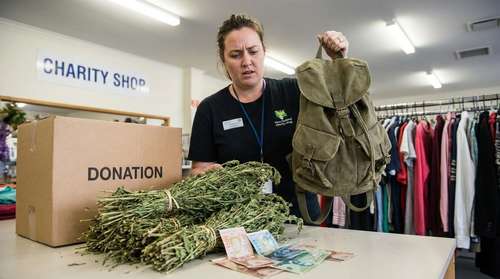
A diligent staff member spotted the misplaced backpack near the front doors and, assuming it was a charitable gift, brought it inside for sorting. Within moments, a distinct, skunky aroma began wafting through the aisles of the thrift store. Upon unzipping the canvas flap, the volunteer was greeted not by old sweaters, but by plastic ziplock bags holding exactly 43.2 grams (around 1.5 ounces) of cannabis, a set of digital scales, and a massive stack of currency totaling $3,700 NZD (roughly $2,200 USD).
Realizing this was far from a standard philanthropic gesture, shop workers swiftly locked down the unexpected inventory and contacted local authorities. As far as the phrase "New Zealand charity shop weed" goes, this incident takes the crown for the most substantial, albeit accidental, contribution on record.
Teens Donate Cash and Drugs, Panic Ensues
The plot thickened just as New Zealand Police were responding to the initial call. The two teenagers returned to the scene of their crime, suddenly realizing they had abandoned their highly lucrative stash on a public sidewalk.
According to authorities, the pair wandered into the store visibly panicked and highly agitated, demanding the return of their "misplaced" property. They grew increasingly aggressive as they tore through the shop searching for the bag, completely unaware that their little error was about to become viral New Zealand news. Instead of recovering their illicit goods, the teens were promptly met by arriving police officers who stepped in to de-escalate the confrontation. The pair were subsequently detained under the Search and Surveillance Act.
When teens donate cash and drugs to a thrift store, it rarely ends in a smooth retrieval. "The quick and calm actions of the shop's staff allowed for a rapid response from police," a police spokesperson noted following the arrests, adding with a touch of irony that it was "not a bad day at the shop". Law enforcement managed to secure the scene before the teenagers could cause any serious disruption to the volunteers or patrons.
Further Discoveries in the Getaway Car
The blunders didn't stop at the store's entrance. Following the apprehension of the two suspects, officers executed a thorough search of the vehicle they had initially dropped off for servicing. That inspection yielded an unlicensed air pistol—which requires a formal license and adult supervision for anyone under the age of 18—along with a police scanner and an additional $810 in cash. While simply owning a radio scanner isn't explicitly illegal in New Zealand, acting on or distributing the intercepted law enforcement information certainly violates the law.
The Legal Aftermath of a Viral Blunder
Because the suspects are 16 years old, they are currently shielded by New Zealand's strict Youth Court privacy laws, meaning their names, backgrounds, and specific charges remain permanently off the public record. Police also opted to keep the precise location of the charity shop confidential to protect the staff members who inadvertently foiled the local drug operation. Safety protocols remain a high priority when civilians accidentally intercept criminal logistics.
Recreational marijuana use and sales remain firmly illegal throughout New Zealand, though some medical applications are permitted under tight restrictions with a valid doctor's prescription. It is incredibly safe to assume these teens were not practicing licensed pharmacy work in the Southland region.
This incident perfectly encapsulates the sheer absurdity of amateur criminal decision-making. Leaving a backpack loaded with contraband on the doorstep of an organization entirely dedicated to taking things from the public and cataloging them is a spectacular unforced error. As this story circulates globally, it cements itself as a hilarious cautionary tale for aspiring lawbreakers. The next time you drop off a box of old homewares, just double-check the pockets—you never know what kind of high-value donation you might accidentally be handing over.