
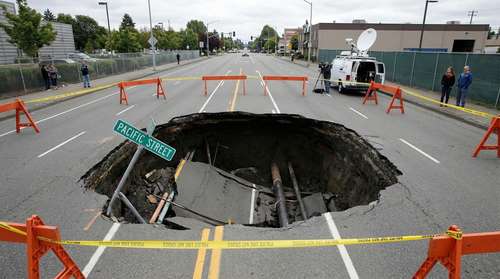
There is a specific kind of digital fascination that only comes from witnessing the solid ground suddenly betray us. If you have spent any time browsing social media over the past few weeks, you have undoubtedly encountered the viral Omaha sinkhole video. The unbelievable footage shows a standard afternoon commute abruptly interrupted when a massive void swallowed two vehicles whole. Now affectionately dubbed the 'Pacific Street Abyss,' this bizarre infrastructure failure has transcended its Midwestern roots to become an international internet phenomenon.
Even though the actual collapse occurred weeks ago and city crews patched the gaping chasm shortly after, the internet refuses to let the spectacle fade. Sparked by new geological data released this week regarding the city's hidden subterranean struggles, the footage has found a massive second life online. It currently stands as a defining piece of viral local news 2026, spawning countless edits, reaction videos, and spirited debates across social media.
The UNO Security Camera Footage That Shocked the World
The sheer shock value of the incident comes down to the undeniable, high-definition visual evidence. The UNO security camera footage facing the busy intersection captured the collapse in stark, unblinking detail. One moment, a silver Ram pickup truck and a maroon Jeep Cherokee are idly waiting at a traffic light on Pacific Street Omaha near 67th Street. The next second, the pavement simply dissolves into the earth, dropping both heavy vehicles into a jagged, subterranean crater.
Fortunately, emergency responders confirmed that both drivers managed to escape the wreckage completely unharmed. That miraculous lack of injuries gave the internet permission to find the dark humor in the situation. Almost immediately, the footage was picked up by major networks like Fox News and the New York Times, eventually airing on broadcasts from Belgium to Vietnam. As City Engineer Austin Rowser accurately observed, if a picture is worth a thousand words, a video of a major thoroughfare turning into an impromptu canyon is priceless.
Unpacking the Omaha Abyss Meme Phenomenon
Without any tragic consequences to anchor it in darkness, the clip rapidly evolved into the Omaha abyss meme. Social media users have creatively repurposed the dramatic drop, treating the disappearing cars as a visual metaphor for unexpected modern anxieties. Creators have paired the plummeting Jeep with whimsical audio tracks, cartoon slipping sound effects, and highly relatable captions about Monday mornings.
The Omaha sinkhole video perfectly encapsulates why certain regional events achieve global virality. It taps directly into a primal, universal human fear: the terrifying realization that the firm ground beneath our feet might actually be a fragile illusion.
What Really Caused the Great Nebraska Road Collapse?
Behind the viral sensation lies a genuine geographical and engineering mystery. For weeks, local officials and utility companies have traded conflicting theories about what triggered this massive Nebraska road collapse. Public Works officials argue that a small, undetected leak in a Metropolitan Utilities District (MUD) water main slowly washed away the surrounding soil over several months. They theorize this rogue water pushed sediment down into the storm sewer, hollowing out a massive cavern underneath the asphalt until it could no longer support the weight of the vehicles.
MUD, however, has fiercely pushed back against that narrative. The utility district suggests that a deteriorating city storm sewer failed first. When the heavy concrete road ultimately caved in, the sheer force and weight of the debris snapped their water line, which they claim is evidenced by sections of dry dirt found inside the freshly opened void.
A Geologist's Warning on the Keystone Trail
Adding an intriguing layer to this piece of weird Nebraska news is a detail straight out of a mystery novel. Harmon Maher, a retired geology professor, was walking along the nearby Keystone Trail on the very morning of the collapse. He noticed the usually gray-green creek water was running a bright, sediment-filled orange. Hours later, that same washed-out sediment would leave a void large enough to claim two large vehicles.
The Hidden Truth About the City's Soil
You might wonder why a fully repaired pothole is dominating timelines again in April. The renewed interest is driven by an extensive analysis published on April 9, 2026, revealing that local city work crews have responded to more than 2,100 reported 'cave-ins' over the past five years.
Geologists explain that the region sits atop a fine-grained sediment called 'loess'. This unique soil composition is highly susceptible to rapid erosion when exposed to moving water. When city workers receive a cave-in report, they often have to play subterranean detectives. Employees frequently inject colored dye into pavement cracks to trace water paths down into the sewer system, allowing them to pinpoint hidden leaks before disaster strikes.
While most of these structural cave-ins are minor pavement dips or small surface cracks, the Pacific Street disaster represents the absolute worst-case scenario playing out in real time. It perfectly highlights why regular infrastructure maintenance is critical in regions with delicate topography.
Repair crews managed to fill the hole, pour fresh concrete, and reopen the street to commuters in an impressive nine days. Physically, the intersection has returned to normal. Yet, in the digital realm, the Omaha sinkhole video ensures that the notorious abyss remains wide open, continuing to rack up millions of views and reminding us all that sometimes, the earth simply decides it is hungry.