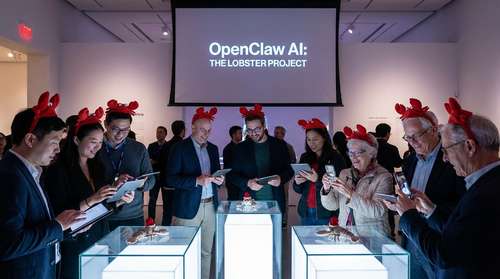
If you have scrolled through social media over the past few days, you might have noticed an inexplicable surge of people wearing oversized crustacean headgear. This is not a belated Halloween parade or a bizarre seafood marketing stunt. Welcome to the OpenClaw AI trend, a fascinating and slightly surreal movement where thousands of tech enthusiasts and retirees alike are donning these accessories to celebrate their new digital assistants. Dubbed 'raising a lobster,' this phenomenon has quickly become the most fascinating tech craze of early 2026.
What is the 'Raising a Lobster' Phenomenon?
To understand why grandmothers and software developers are waiting in long lines together wearing viral lobster cosplay, you have to look at the software beneath the shell. OpenClaw is an open-source, autonomous AI agent created by Austrian developer Peter Steinberger. Unlike standard passive chatbots that simply answer questions, this agent actually takes control of tasks. It can triage your chaotic inbox, book flights, manage your calendar, and execute complex, multi-step workflows across your devices.
The crustacean connection started as an inside joke. Originally named Clawdbot, the software quickly adopted a lobster emoji as its unofficial mascot. Community members started referring to the setup process as raising a lobster or 'lobster farming'. The metaphor is surprisingly fitting: running an autonomous AI agent requires a dedicated environment, constant care, and feeding it a steady stream of data and API tokens.
Inside the OpenClaw Installation Events
While the software itself is digital, the culture around it has spilled aggressively into the physical world. Across major tech hubs, particularly in Asia, OpenClaw installation events have become massive social gatherings. Because setting up the agent requires specialized cloud servers and complicated configuration, a booming cottage industry has emerged to help non-technical users get their own digital crustacean up and running.
Attendees show up to these grassroots tech clinics eager to learn, and the atmosphere is nothing short of a festival. The sight of the red claw hats viral trend taking over tech headquarters and local community centers has been a goldmine for internet culture. It is easily one of the most memorable pieces of funny AI news 2026 has delivered so far, blending high-end autonomous computing with unapologetically silly physical props.
Why Retirees Are Joining the Craze
Perhaps the most surprising demographic jumping on these weird tech trends is the older generation. Recent reports from early April highlight a massive influx of retirees attending these installation drives. Many are looking to leverage their new digital agents for side hustles, while others want a smart assistant to organize specialized industry knowledge they acquired over decades of working. For them, the playful branding demystifies a highly complex technology, making an autonomous computing agent feel like a manageable virtual pet.
The Costs and Risks of Your Digital Crustacean
Despite the cheerful headgear, managing one of these agents is not without its sharp edges. The system requires full shell access to a user's computer or cloud instance, meaning it has the power to read files, execute scripts, and control browsers. Steinberger himself famously described the underlying architecture as 'spicy' because of the immense trust required to let an AI loose on your hard drive.
Furthermore, keeping these agents fed is expensive. Because the system constantly spawns parallel sub-agents to solve problems, it burns through API tokens at an astonishing rate. Some inexperienced 'farmers' have woken up to find their agents spent fifty dollars overnight because of a misconfigured background process. The cottage industries that once charged to install the software are now making money helping users clean up accidental file deletions or rein in out-of-control API billing.
Will This Weird Tech Trend Last?
The explosion of this movement proves that the general public is desperately hungry for technology that actually does the heavy lifting, rather than just generating text. Nvidia CEO Jensen Huang recently referred to the agent as the next ChatGPT, and the rapid adoption rates suggest he might be right. Whether the intense enthusiasm will hold remains to be seen, but the massive surge in hardware sales and cloud server rentals indicates real economic impact.
Even if the novelty fades and the plush accessories are eventually stuffed into closets, the current moment marks a definitive shift. We have crossed the threshold from chatting with machines to delegating our digital lives to them. For now, the lobster is officially out of the tank, and the internet is completely obsessed with watching it grow.