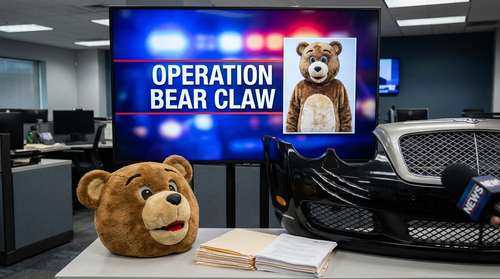
When you file an auto insurance claim for a wild bear attack, you should probably make sure the "bear" isn't wearing a zipper. In what is easily one of the most ridiculous plots to cross a prosecutor's desk this year, three people have officially been sentenced for their roles in Operation Bear Claw. If you haven't been keeping track of Los Angeles weird news, this case involves a head-to-toe grizzly bear costume, kitchen meat claws, and an audacious attempt to fleece insurance companies out of six figures.
The bear suit insurance fraud scheme formally ended this week when a judge handed down sentences to the California trio, capping off an investigation that has left law enforcement scratching their heads. While the criminals may have thought they were orchestrating the perfect heist, forensic biologists and sharp-eyed insurance adjusters easily saw right through the charade.
The Anatomy of a Luxury Car Insurance Scam
The grift officially began back in January 2024, when an insurance claim was filed for a supposed wildlife incident in Lake Arrowhead, a mountain community located just east of Los Angeles. The suspects alleged that a massive black bear had broken into a 2010 Rolls-Royce Ghost, aggressively clawing at the leather interior and causing thousands of dollars in property damage.
To sweeten the pot, the group didn't just stop at the Rolls-Royce. The perpetrators eventually filed two additional claims for the exact same date of loss and location, this time citing bear damage inside a 2015 Mercedes G63 AMG and a 2022 Mercedes E350. Across all three vehicles, the group managed to stick insurers with a total loss of $141,839.
The sheer improbability of an aggressive bear methodically breaking into three specific luxury vehicles in one night quickly raised red flags. This wasn't a random act of nature; it was a highly coordinated luxury car insurance scam that relied on the insurers paying out without asking too many questions. The suspects clearly banked on the fact that California does have a genuine issue with wildlife damaging property. Just late last year in 2025, a real black bear became trapped inside a resident's vehicle in Lake Tahoe, completely shredding the upholstery. The fraudsters likely hoped this genuine regional problem would lend surface plausibility to their fabricated claims.
Exposing the Fake Bear Attack Video
The linchpin of the group's insurance claim was home security footage that purportedly showed the animal in the act. The suspects submitted the clips to the insurers, hoping the grainy, nighttime visuals would be enough to fast-track their payout.
When state insurance regulators caught wind of the suspicious pattern, they brought in an expert from the California Department of Fish and Wildlife to review the footage. It didn't take long for the biologist to confirm what investigators already suspected: the animal lumbering around the front seats was entirely bipedal. The expert concluded that the footage was nothing more than a fake bear attack video featuring a painfully obvious human in a bear suit.
Armed with this analysis, detectives secured a search warrant for the suspects' Glendale and Valley Village homes. During the raid, authorities uncovered the smoking gun—a full-body bear costume complete with a furry headpiece, alongside handheld kitchen meat shredders that the group used to simulate deep claw marks on the expensive leather upholstery. It was a cartoonish setup, but the financial damage they caused was very real.
Operation Bear Claw Leads to Arrests
The California Department of Insurance, recognizing the unique absurdity of the case, officially dubbed their investigation Operation Bear Claw. The state pushed forward with felony charges, proving that wildlife fraud requires a lot more than a cheap Halloween costume and some culinary tools.
The Sentences Handed Down for the "Bears"
The legal fallout arrived this April, bringing one of the most memorable funny crime stories 2026 has offered to a definitive close. Following no-contest pleas to felony insurance fraud, three Los Angeles-area residents learned their fate.
Alfiya Zuckerman, 39, of Valley Village, and Ruben Tamrazian, 26, of Glendale, were both ordered to serve 180 days in a weekend jail program and complete two years of supervised probation. The court also ordered Zuckerman to pay $55,360 in restitution, while Tamrazian is on the hook for $52,268.
A third accomplice, 32-year-old Vahe Muradkhanyan, received the same 180-day weekend jail sentence and two years of probation, though his final restitution amount is still pending. Meanwhile, a fourth suspect in the ring, Ararat Chirkinian, 39, is scheduled to appear for a preliminary hearing this coming September.
Why Weird World Headlines Like This Cost Everyone
While the image of a grown adult wearing a fur suit to punch the dashboard of a Mercedes seems hilarious, authorities are reminding the public that there are real victims in these types of financial crimes.
According to California Insurance Commissioner Ricardo Lara, these staged events directly affect the wallets of honest drivers. When companies are forced to write off over $140,000 for fabricated claims, those financial losses are inevitably passed down to regular consumers through higher auto premiums. Industry experts point out that premium leakage and auto fraud cost American drivers tens of billions of dollars every single year.
The successful prosecution of Operation Bear Claw proves that no matter how creative a scam might seem, investigators have the tools to pull back the curtain. For now, the only place these fraudsters will be hibernating is in a county jail facility. It's a fitting end to a crime that has captured weird world headlines and shown exactly what happens when bad actors try to cheat the system.