
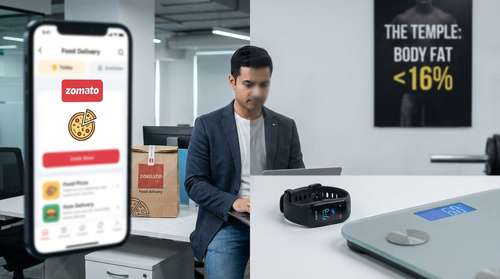
If you were planning to polish off a butter chicken while updating your resume for Deepinder Goyal’s latest venture, put the fork down. The Zomato founder has sparked a fresh internet firestorm, but this time it isn’t about platform fees or delivery times. It’s about your waistline.
Goyal’s new health-tech startup, Temple, has posted a hiring announcement that reads more like a casting call for Gladiator II than a software engineering role. The core requirement? A strict body fat limit. The internet, naturally, has exploded with memes, pointing out the delicious irony of a food delivery tycoon demanding single-digit body fat percentages.
The 'Temple' Mandate: No Abs, No Offer Letter?
On February 27, Goyal took to social media to announce a recruitment drive for 'Temple,' his new deep-tech venture focused on elite athletic performance. The roles are highly technical, seeking computational neuroscientists, embedded systems engineers, and machine learning experts.
But technical prowess isn't enough. The job post came with a bold condition: "Only people who take fitness seriously, and have body fat <16% (men) and <26% (women) should apply."
Goyal offered a slight reprieve for those currently missing the mark: candidates who don't meet the criteria can still apply if they commit to reaching the target within three months. However, they will remain on "probation" until they hit the gym goals. His rationale? Authenticity.
"We are building for people who push their bodies to the edge. We want to be those people, not just serve them," Goyal wrote, adding that he wants engineers who will "wear what they build, and hate it until it's perfect."
"Step 1: Delete Zomato" – The Internet Reacts
Social media users were quick to spot the paradox. Deepinder Goyal is best known for democratizing access to biryani and pizza via Zomato, a service that—let’s be honest—isn't exactly synonymous with 16% body fat.
The trolling was instantaneous and creative. One viral comment summed up the general sentiment: "Fun fact: To get under 16% body fat, you literally have to stop using the CEO's other product."
Other users joked about the absurdity of the requirement for desk-bound coding jobs. "I don't think there exists an Embedded Systems Engineer with less than 16% body fat," one user quipped. Another added, "We really got body fat as a hiring criteria before GTA 6."
While some fitness enthusiasts praised the move as a bold commitment to company culture, others criticized it as exclusionary, questioning how a developer's BMI correlates with their ability to write efficient code or design a circuit board.
What is 'Temple'? (Besides a Gym for Coders)
Amidst the meme frenzy, details about the startup itself are surfacing. Temple is not just another Fitbit clone. The company recently raised $54 million and is valued at approximately $190 million. It aims to build "the ultimate wearable for elite performance athletes."
The device, which Goyal has been spotted wearing on his temple (hence the name), reportedly measures cerebral blood flow and other physiological metrics with a precision that currently doesn't exist in the consumer market. It stems from Goyal's personal interest in longevity and his "Gravity Ageing Hypothesis," which explores how gravity affects blood flow to the brain over time.
The "Chief of Stuff" Precedent
This isn't the first time Goyal has used unconventional hiring tactics to filter for "high-agency" individuals. Recently, he made headlines for a "Chief of Staff" role that required the applicant to pay a ₹20 lakh fee for the first year (which would be donated to charity), effectively ensuring the candidate wasn't doing it for the money. That move also drew sharp criticism before being clarified as a filter for genuine intent.
A New Era of "Skin in the Game"?
Goyal’s strategy reflects a growing trend among intense founder-led startups to demand "missionaries, not mercenaries." By enforcing a lifestyle requirement, Temple is signaling that it wants employees who live the brand's philosophy 24/7.
However, legal and HR experts might raise eyebrows at medical-based hiring criteria for non-physical roles. For now, though, the message from the Zomato chief is clear: If you want to build the future of bio-wearables, you’d better be ready to sweat for it—literally.