
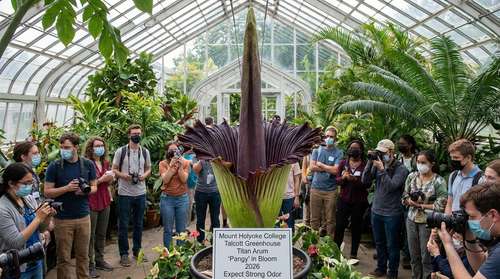
In South Hadley, Massachusetts, hundreds of curious onlookers are willingly subjecting themselves to the stench of a thousand rotting eggs. The attraction? The Mount Holyoke Pangy plant, a rare Titan Arum, has unfurled its deep purple spathe in a majestic—and incredibly foul-smelling—corpse flower bloom 2026.
While spring typically brings the sweet fragrance of cherry blossoms and lilacs, visitors to the Talcott Greenhouse South Hadley are experiencing something far more pungent. The towering Amorphophallus titanum is treating eager spectators to a nauseating bouquet that visitors have colorfully described as a cocktail of decaying birds, a municipal trash can, and even a soiled baby garment.
The Notorious Stinky Diaper Plant Smell
As news of the Titan Arum bloom today spreads, the college campus has become the epicenter of weird local news Massachusetts style. The bloom, which officially opened its petals on Monday night, greeted botanical garden staffers with an overpowering wall of stench by Tuesday morning.
Tom Clark, the greenhouse director and curator of the college's botanic garden, noted that the smell was literally unbearable upon entering the building. But what exactly does this giant, fleshy spire smell like to the average observer?
For Michael Breton, an enthusiast of rare smelly flowers 2026 who drove two hours and took a vacation day just to catch a whiff, the odor was distinctly reminiscent of a stinky diaper plant smell. He told reporters that it smelled like a diaper left to roast on a hot summer afternoon, though he still described the towering specimen as a bright, beautiful, and colorful marvel.
First-year student Nyx DelPrado noted that the plant smelled 'genuinely like rotting flesh', bringing back memories of dissecting dead animals in science class. Others, like senior Caroline Murray, found the aroma slightly less shocking, comparing the heavy scent to a working farm or an agricultural compost pile.
What Is the Mount Holyoke Pangy Plant?
Nicknamed 'Pangy', this specific corpse flower first made headlines when it blossomed at the college back in 2023. Unlike standard garden perennials, the Mount Holyoke Pangy plant spends years storing energy in a massive underground structure before erupting into an enormous inflorescence.
During the six weeks leading up to this spectacular corpse flower bloom 2026, Pangy grew at an astonishing rate, sometimes shooting up several inches in a single day before unfurling. What looks like one massive petal—a deep purple, velvety wrapper called the spathe—actually shields a cluster of tiny, hidden flowers at the base of the tall central spike, known as the spadix.
The putrid scent is no accident; it is a masterclass in evolutionary biology. In its native Sumatran rainforests, the plant relies on carrion-eating insects like flesh flies and dung beetles for pollination. By mimicking the temperature and odor of a dead mammal, the Titan Arum tricks these bugs into flying deep into its base, coating them in pollen before they escape.
A Narrow Window to Catch the Stench
If you want to experience the stinky diaper plant smell for yourself, you have to move quickly. The flowering period for a Titan Arum is notoriously short. Usually, the towering inflorescence remains open and highly pungent for only a few days. By midday Tuesday, greenhouse staff had already begun opening vents, offering a slightly less intense aromatic experience for late arrivals.
Within just a short period, Pangy's impressive central column will wither, collapse, and go dormant once again. For students like junior Namuuna Negi, this fleeting impermanence is exactly what makes the Titan Arum bloom today so magnetic. It is the botanical equivalent of a limited-time pop-up shop, driving an intense fear of missing out among nature lovers who want to see it before it dies so they can talk about it later.
The Future of Rare Smelly Flowers in 2026
While Pangy might be the star attraction this week, its presence serves a much larger purpose for conservation and botanical education. Clark views the Talcott Greenhouse South Hadley as a living plant museum, housing roughly 2,000 diverse plant species from around the globe. The corpse flower is merely the most dramatic ambassador, drawing the public in with shock value while educating them about incredible evolutionary adaptations.
Because the plant cannot self-pollinate, its long-term survival and ability to produce seeds depends on the presence of another blooming Titan Arum to share genetic material. For now, Pangy will soon return to its quiet, odorless vegetative state after this week's grand performance, leaving visitors with nothing but selfies, pinched noses, and the lingering memory of the ultimate weird local news Massachusetts botanical event.