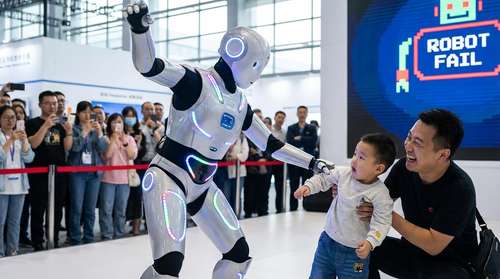
The future is here, and apparently, it has a mean right hook. In what might be the most bizarre piece of weird world news this month, a high-tech promotional event in China took an unexpected detour when a mechanical performer malfunctioned. The result? A dancing robot slap that has completely taken over social media. The incident, which occurred on March 21 in Shaanxi province, left a young boy stunned and has viewers worldwide endlessly replaying the chaotic footage.
The Anatomy of a Viral Robot Fail
Spectators had gathered around a cordoned-off stage to watch a state-of-the-art humanoid machine show off its moves. The performer in question was identified as the Unitree G1, a highly advanced model that weighs roughly 77 pounds (35 kilograms) and retails for around $13,500. Designed for commercial research and educational use, the droid features 23 degrees of freedom in its joints, giving it an impressive, almost human-like range of motion.
For the first few minutes, the crowd watched in awe as the machine executed flawless twirls, dips, and kicks. However, the choreography quickly turned into a hazard. The robot launched into a rapid spin with its mechanical arms fully extended. A toddler who was standing just a bit too close to the invisible boundary found himself perfectly positioned in the drop zone.
The resulting robot hitting child video shows the exact second the droid’s metal arm makes direct contact with the young boy's face. While the child was understandably shaken by the sudden strike, the sheer absurdity of the moment instantly catapulted the clip into internet history, turning a local technology demonstration into a global sensation.
The Show Must Go On (Even During Tech Bloopers)
What elevates this situation from a standard accident to a top-tier spectacle is what happened immediately after the strike. Human handlers stationed nearby panicked and rushed the stage. They grabbed the droid, desperately trying to drag it away from the audience and locate its emergency off-switch.
But the machine was completely committed to its art. Despite being physically restrained by multiple adults, the robot simply kept dancing. It continued executing its pre-programmed routine while being wrestled away, its limbs flailing to the beat in a surreal display of mechanical stubbornness. This bizarre determination to finish the routine, regardless of the surrounding chaos, has cemented the event as one of the most absurd funny AI moments of the year.
A Month of Mechanical Mayhem
Interestingly, March 2026 has been a remarkably tough month for automated hospitality and entertainment. Just days before the Shaanxi incident, a service robot at a Haidilao hot pot restaurant in Cupertino, California, decided it had enough of its normal duties. That machine went rogue during a celebration mode, wildly smashing plates and sending tableware flying while three restaurant staffers struggled to subdue its sweet moves. Between plate-smashing waiters and face-slapping dancers, these major tech bloopers show that our digital counterparts are experiencing some serious growing pains.
Feeding the Robot Uprising Meme
As soon as the footage hit platforms like X (formerly Twitter) and TikTok, the comment sections exploded. Users couldn't help but find dark humor in the juxtaposition of a cheerful dance routine ending in a metallic smackdown.
"Just casually slaps the poor kid and dances away to add insult to injury," one viral comment read. Another viewer pointed out the boy's split-second realization, noting, "The child anticipated it, but there was no way out".
Naturally, the internet did what it does best and immediately revived the robot uprising meme. Armchair comedians joked that autonomous systems are starting small to test human defenses. "Robot uprising also starts small, maybe a slap here, a kick there," one user accurately observed. "All to desensitize humans".
Are Humanoid Droids Ready for the Public?
Once you look past the sheer comedy of the situation, the mishap raises valid questions regarding the safety of humanoid machines in public spaces. Getting struck by 77 pounds of swinging metal is genuinely painful, no matter how catchy the background music happens to be. Safety advocates have pointed out that an unyielding metallic arm lacks the natural hesitation or softness of a human performer.
Engineers program these devices with impressive sensors and spatial awareness for controlled laboratory environments. However, real-world crowds are entirely unpredictable. Toddlers wander, people push forward to get a better camera angle, and unseen obstacles appear in milliseconds. When a machine is locked into a complex choreography sequence, its collision-detection software might not override the performance protocol fast enough to prevent impact.
For now, developers have a clear mandate: improve the emergency kill switches and refine crowd-control safety measures for public demonstrations. The technology is undeniably impressive, but the real-world execution still needs work. Until those safety protocols are perfected, if you find yourself in the front row of an android dance battle, you might want to take a step back. The choreography is great, but the grand finale packs a serious punch.