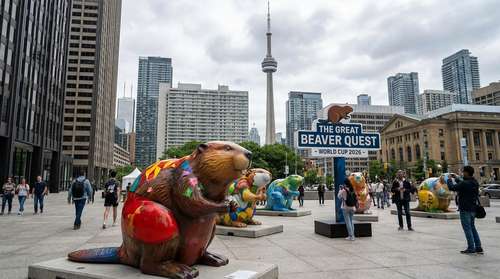
Beaver fever has officially struck Canada’s largest city, and it is not your average wildlife invasion. If you stroll near St. Lawrence Market, the historic Distillery District, or the Hockey Hall of Fame this week, you might find yourself staring down a four-foot-tall rodent grinning widely and clutching a soccer ball under its right paw. Welcome to The Great Beaver Quest, an ambitious and highly photogenic outdoor exhibition featuring 51 Toronto beaver statues that have rapidly transformed the downtown core into a vibrant, interactive artistic playground.
Timed perfectly with the kickoff of the highly anticipated global soccer matches arriving in town this week, this massive installation brings a welcome dose of eccentricity to the city streets. Dropping right into the sweet spot of weird world news, the project was launched by the Old Town Toronto Business Improvement Area (BIA) in partnership with STEPS Public Art. It serves a brilliant dual purpose: giving international tourists a uniquely Canadian greeting, and providing local residents a compelling reason to rediscover the businesses in their own backyard.
Anatomy of a Toronto World Cup 2026 Scavenger Hunt
You cannot miss these colorful figures popping up under park trees, peering through corporate office windows, and standing guard at busy intersections. Out of the 51 giant beaver sculptures currently blanketing Old Town Toronto, 48 are meticulously designed to represent the nations competing in the 2026 FIFA World Cup. The remaining three hold special significance: two are dedicated to welcoming the world, while a single statue celebrates the vibrant history of the neighborhood itself.
Reminiscent of the famous "Moose in the City" project that saw hundreds of decorated moose statues dot Toronto in the year 2000, this modern spiritual successor turns urban exploration into a gamified experience. As the ultimate Toronto World Cup 2026 scavenger hunt, tourists and locals alike can scan QR codes attached to the statues.
How to Play and Win
To jump into the action, urban explorers simply need a smartphone and a comfortable pair of walking shoes. Scanning the QR code located on the base of any statue directs players to the official Great Beaver Quest digital platform. From there, users follow clues to track down the remaining statues. At each stop, participants are prompted to complete localized challenges—ranging from trivia about the participating nations to snapping photos with the artwork. Every completed task accrues points, unlocking entries into a prize pool fully funded by the BIA and valued at $3,300 in gift cards to local businesses. Participants should brush up on their arithmetic, though—claiming a prize requires correctly answering a time-limited mathematical skill-testing question.
Showcasing Global Cultures Through World Cup Toronto Public Art
What elevates these statues from simple tourist magnets to meaningful World Cup Toronto public art is the intensive community collaboration behind them. Each sculpture was hand-painted by local artists who hold cultural ties, family roots, or deep connections to the country they represent.
Tributes from Argentina to Ecuador
The details hidden within the acrylic brushstrokes are remarkable. Canadian-Argentine artist Elena Dri designed a beaver wearing a poncho that, when viewed from the side, pulls back to reveal a tattoo of Lionel Messi kissing the World Cup trophy alongside three championship stars. Meanwhile, artist Tetyana Bibik embraced the language and diverse culture of Ecuador for her commission. Her beaver firmly grips the nation's signature chuquiragua flower while displaying references to the Galapagos Islands and Indigenous-inspired arm tattoos.
An Indigenous Welcome
Anchoring the exhibition is the primary welcome sculpture created by Barrie-based artist Monica Loney. Drawing from her Indigenous roots, Loney utilized Woodland-style art—an aesthetic popularized by Ojibwe artist Norval Morrisseau—to weave black pathways across a canvas of international flags. The interconnected lines represent the unity of land, water, and people, layered with Métis-inspired floral beadwork patterns where each painted dot symbolizes community resilience.
More Than Just a Selfie Backdrop
While the toothy totems are undoubtedly generating massive engagement on social media, the underlying goal extends beyond viral moments. As Old Town Toronto BIA Executive Director Al Smith noted as the statues hit the streets, the initiative is an opportunity to welcome tourists while supporting the local economy. The neighborhood encompasses 10 of Toronto's original city blocks, housing a dense concentration of restaurants and independent shops. By scattering the sculptures across this footprint, organizers are strategically funneling massive international foot traffic directly toward merchants who rely heavily on summer tourism.
Whether you are a die-hard soccer fan traveling thousands of miles to watch your home country play, or just a neighborhood resident looking to spot a beaver wrapped in traditional Canadian plaid, this interactive gallery delivers. The statues will remain on their urban posts through the end of September, ensuring that even after the final stadium whistle blows, the city's quirky welcoming committee will still be grinning from ear to ear.