
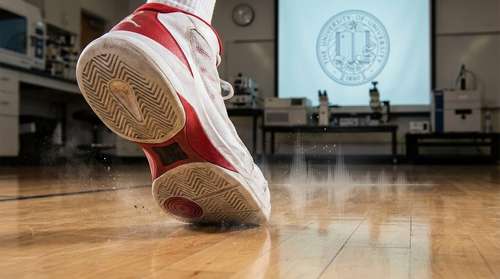
It is the soundtrack of every basketball game, from the local YMCA to the NBA Finals: the piercing, rhythmic squeak of sneakers on hardwood. For decades, fans and players have accepted this noise as a byproduct of the game, a sign of good grip and intense defense. But until now, the exact physics behind that signature chirp remained a mystery. In a groundbreaking study published today in the journal Nature, researchers from Harvard University have finally decoded the complex mechanics of the sneaker squeak, revealing a process far more violent and intricate than simple friction.
The Physics of the Squeak: It's All About the Snap
Led by materials scientist Adel Djellouli at the Harvard John A. Paulson School of Engineering and Applied Sciences (SEAS), the team discovered that the sound is not caused by the rubber sliding smoothly. Instead, it is the result of what they call "opening slip pulses." When a basketball shoe plants and slides against the court, the rubber sole doesn't just drag; it buckles.
Using high-speed cameras capable of capturing one million frames per second and a specialized glass plate to view the contact patch from below, the researchers observed that tiny wrinkles form in the rubber. These wrinkles detach from the floor and snap back into place at incredible speeds—traveling across the sole near the speed of sound. This rapid-fire detachment and reattachment happens roughly 4,800 times per second. It is this high-frequency vibration of the rubber snapping back against the floor that compresses the air and produces the high-pitched squeak we hear.
Why Tread Pattern Matters More Than You Think
One of the study's most surprising findings is that the rubber compound alone isn't enough to produce the iconic sound; the geometry of the sole is crucial. When the team tested flat blocks of rubber without any tread, they didn't get a clean squeak. Instead, the smooth rubber produced a chaotic, muddled "whoosh" sound.
The Role of Ridges
The researchers found that the grooves and ridges on a basketball shoe act as waveguides. They organize the slip pulses, trapping them into a regular, periodic cycle. This structure forces the wrinkles to travel in a uniform way, creating a clear, tonal frequency rather than white noise. This explains why worn-out shoes with bald spots often lose their characteristic sound before they lose all their grip—without the ridges to channel the vibration, the "squeak" falls apart acoustically.
From the Celtics Game to the Lab
The inspiration for this study didn't come from a textbook, but from the TD Garden. Adel Djellouli was watching a Boston Celtics game when the ubiquitous noise sparked his curiosity. "This squeaking sound when players are sliding on the floor is omnipresent," Djellouli noted. "It's always there, right?"
Driven by this question, he returned to the lab to recreate the phenomenon. The team built a contraption to slide a sneaker repeatedly against a glass surface while recording both the audio and the microscopic interactions at the interface. This combination of high-speed video and synchronized audio allowed them to map the visual buckling of the rubber directly to the sound waves, confirming that the "rippling" of the shoe was the source of the noise.
Sneakers, Earthquakes, and Miniature Lightning
The implications of this research extend far beyond the basketball court. The physics observed in the snapping rubber—where energy builds up and releases in sudden bursts—mirror the mechanics of earthquakes, just on a much smaller scale. The "slip pulses" in your sneakers behave similarly to the rupture fronts along geological faults.
In an even stranger twist, the high-speed cameras captured faint flashes of light during the experiments. The friction generated enough static electricity to create triboelectric discharges—essentially miniature lightning bolts—between the rubber and the glass. While these tiny sparks don't contribute to the sound, they highlight the immense energy being exchanged in those split-second movements.
While this new understanding might not change how you play, it opens the door for engineers to design "tunable" friction materials. Future shoes could be engineered to grip silently for stealth or squeak at specific frequencies. But for now, that familiar chirp remains the ultimate sound of hustle.