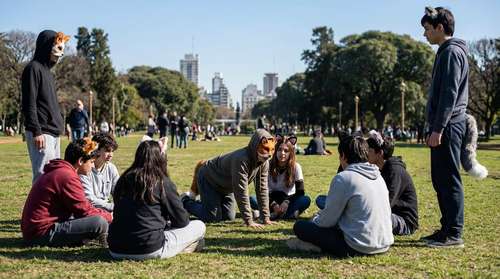
This past weekend, unsuspecting locals enjoying a quiet Sunday stroll through city plazas were met with an extraordinary sight: groups of teenagers bounding across the grass on all fours, wearing lifelike masks, and vocalizing like wild beasts. Welcome to the epicenter of the Argentine animal trend, a viral phenomenon that is rapidly transforming urban public spaces into makeshift wildernesses.
Participants of this subculture call themselves "Therians"—individuals who claim to possess a non-human internal identity, connecting mentally, spiritually, or psychologically with an animal species. While the concept isn't entirely new, recent Buenos Aires park news highlights a massive surge in coordinated park packs gathering offline. What started as an internet curiosity has officially leaped off the screen, establishing itself as a prominent piece of weird world news 2026.
The Rise of the Pack: Taking Over TikTok and the Parks
The movement's massive scale is undeniable. On social media platforms like TikTok, therianthropy viral videos have exploded, with the main hashtag surpassing 2 million posts. Argentina currently leads all Latin American countries in engagement for this specific subculture. Over the last 48 hours, these digital communities coordinated their latest real-world meetups, drawing hundreds of curious onlookers and participants to major public squares.
At the forefront of these gatherings is Aguara, a 15-year-old girl who identifies as a Belgian Malinois dog. As the self-appointed leader of her local pack, she boasts over 125,000 TikTok followers. During the weekend's event, she effortlessly cleared obstacle courses while mimicking the precise, athletic movements of her canine counterpart. "I simply have moments when I like being a dog," she told reporters, noting that otherwise, she lives a completely normal, functional human life.
More Than Just a Game: Identity vs. Performance
The broader animal identification movement is remarkably diverse. Not everyone bounding through the parks truly believes they possess an animal soul. Take 16-year-old Aru, who arrived at the weekend gathering sporting a realistic seal mask. She identifies with the "otherpaw" branch of the community, which consists of teenagers who wear tails and practice "quadrobics"—moving on all fours—strictly for fun and exercise.
This physical aspect requires immense stamina and agility. Teenagers spend hours practicing how to run, jump, and land safely on their hands and feet, often sharing tutorials online. For many participants, mastering the physical movements of foxes, cats, or hunting dogs is a point of immense pride and serves as a unique alternative to traditional organized sports. The shared dedication to this physical craft has forged deep bonds among the youth, creating a support network that extends far beyond their weekend park activities.
For Aru, it isn't strictly about identifying as animals; it is about community and creative expression. She attributes the sudden explosion of the subculture to Argentina's historically free and expressive environment, which provides teenagers a vital space to feel truly accepted among their peers.
What the Experts Say
As the trend dominates public discourse, mental health professionals are stepping in to analyze the fascination. Débora Pedace, a psychologist and director of the Integral Therapeutic Center in Buenos Aires, explains that from a psychological standpoint, this behavior represents a symbolic identification. Pedace reassured concerned parents that the activity only becomes alarming if the individual loses touch with reality, fully assumes the role of an animal, or engages in self-harm. For the vast majority of these teens, it remains a harmless, albeit highly unusual, social outlet.
Backlash, Culture Wars, and 'Anti-Therian' Protests
The rapid visibility of these youths has predictably sparked intense cultural friction. Online, the phenomenon is frequently dismissed by older generations as peak Gen Z weird behavior. In recent days, the hostility has escalated from online mockery to organized real-world opposition.
False rumors have circulated on platforms like Reddit and Telegram, mirroring past North American moral panics by falsely claiming that local schools are providing litter boxes for students. These baseless stories are often amplified by far-right agitators who frame the subculture as a symptom of progressive social engineering. In response to the latest park gatherings, newly formed "anti-therian" groups attempted to mobilize counter-protests, demanding that public spaces be cleared of the costumed teenagers.
Despite the growing backlash, the local Therian community shows no signs of retreating into the shadows. As long as the parks remain open and the viral videos continue to rack up millions of views, Buenos Aires will likely remain the unexpected global capital of this fascinating youth subculture.