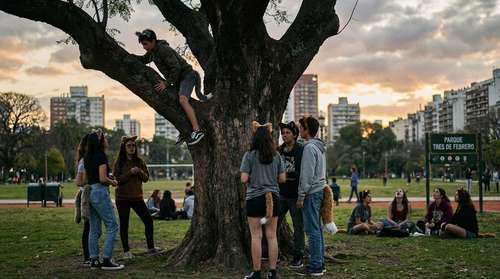
On a seemingly ordinary Sunday in late February, a public plaza in Buenos Aires transformed into something far wilder than a typical city park. Young people, moving with uncanny agility on all fours, leapt over obstacles and perched high in tree branches, barking, howling, and mimicking the behaviors of dogs, cats, and foxes. This wasn't a theatrical performance or a costume party—it was a gathering of the Therian movement 2026, a rapidly growing subculture of teens identifying as animals that has exploded across Argentina.
The Buenos Aires 'Howl-In' That Went Viral
The footage is surreal and undeniable. In a video that has racked up millions of views on TikTok, a 15-year-old known as "Aguara" clears a hurdle with the precise, athletic grace of a Belgian Malinois, the dog breed she identifies as. Nearby, "Sofia" sprints across the grass on her hands and knees, wearing a realistic beagle mask, while others—dressed as felines—watch silently from the limbs of trees above.
This event, which took place on February 22, 2026, has thrust the human-animal identity subculture into the global spotlight. While the hashtag #therian has accumulated over 2 million posts worldwide, recent data shows that Argentina is leading Latin America in engagement. What was once a niche online community has physically manifested in the streets of Buenos Aires, creating scenes that have left bystanders and internet users alike oscillating between fascination and confusion.
Inside the Pack: Spiritual Identity vs. 'Otherpaw' Fun
To understand this viral animal identity trend, one must distinguish between the different levels of participation. For leaders like Aguara, who boasts over 125,000 TikTok followers, being a Therian is a deep-seated spiritual or psychological connection. She describes her "pack" not just as a friend group, but as a family bound by a shared non-human experience. "I wake up like a normal person and live my life like a normal person," Aguara told reporters. "I simply have moments when I like being a dog."
However, not everyone in the park shares this intense internal identity. A growing subset known as "Otherpaw" participates strictly for the fun and athleticism of the movement. Aru, a 16-year-old attendee wearing a seal mask, clarified this distinction to local media. "It's not necessarily about identifying as an animal," she explained, noting that for many, the masks (often called "gear") and the quadrupedal movement (walking on all fours) are a form of creative expression and physical challenge rather than a spiritual belief.
Creating Habitats: From City Parks to Suburban Nests
The trend has evolved beyond simple meetups. Reports indicate that the immersion is deepening, with some teens creating makeshift "habitats" in their personal spaces. While the sight of teens climbing trees in public parks has become the most visible aspect of this weird world news Argentina story, online communities are buzzing with tutorials on how to build "nests"—cozy, den-like spaces in bedrooms or yards where Therians can retreat to feel safe and connected to their 'theriotype' (their specific animal identity).
This physical reclaiming of space is a key part of the movement's appeal. In a digital age where social interaction is often mediated through screens, the Therian community offers a tactile, physical outlet. The "gear"—often handmade masks and tails—serves as a signal of belonging, allowing these young people to find their "pack" in a crowded urban environment.
Psychological Perspectives: Cause for Concern?
As with any strange viral news stories involving youth culture, adults are asking: Is this healthy? The intense commitment to animal personas has sparked debates among parents and educators. However, mental health experts are urging a measured response.
Débora Pedace, a prominent psychologist and director of the Integral Therapeutic Center in Buenos Aires, views the trend through a lens of adolescent exploration rather than pathology. "From a psychological standpoint, this is a symbolic identification with an animal," Pedace explained in a recent interview. She notes that adolescence is a time of identity formation, and for this generation, that exploration has taken a novel form.
Pedace warns that the behavior only becomes alarming if it detaches a young person from reality. "It becomes pathological only when it turns into a deeply rooted belief and the person fully assumes the role of an animal, potentially leading to self-harm or hurting others," she clarified. For the vast majority of the teens gathering in Buenos Aires parks, however, the movement appears to be a social activity—a way to find community in an increasingly fragmented world.