
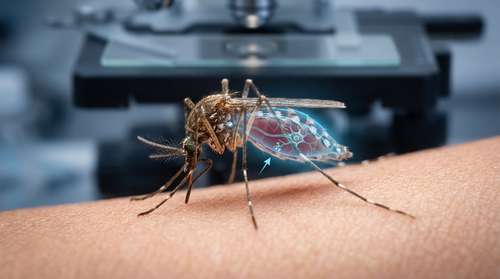
If you have ever swatted a grossly inflated mosquito leaving a Jackson Pollock-style blood splatter on your arm, you might have wondered just how much these tiny vampires can actually drink. In a fascinating update to entomological research published yesterday, March 21, 2026, researchers have confirmed an incredibly bizarre biological mechanism dictating mosquito feeding habits. As it turns out, female mosquitoes do not use their brains to gauge their appetite or decide when they have had enough to drink. Instead, they rely entirely on their "butts"—specifically, specialized sensory nodes located in their abdomens—to signal that the tank is full.
The Bizarre Mechanics Behind Mosquito Feeding Habits
When a female mosquito lands on your skin, she is on a singular, aggressive mission to harvest the proteins necessary for her eggs to properly mature. However, her microscopic brain is notoriously bad at portion control. Left strictly to the brain's decision-making processes, the insect would never stop sucking blood. According to the latest scientific consensus confirming earlier experiments by researchers like Dr. Perran Stott-Ross from the University of Melbourne, a mosquito will simply keep drinking until her abdomen physically stretches to its absolute structural limit.
This is where the evolutionary magic of insect abdominal receptors comes into play. As the host's warm blood flows into the digestive tract, the mosquito's gut expands rapidly, ballooning the surrounding exoskeleton.
How Mosquito Stretch Receptors Save Them From Themselves
The insect's abdomen is equipped with highly sensitive mechanoreceptors embedded in the gut wall. These mosquito stretch receptors act as an emergency fail-safe mechanism. As the gut balloons—sometimes holding up to four times the insect’s original body weight—the physical stretching of the tissue triggers an immediate neurological response. This bottom-up feedback loop sends a desperate signal through the ventral nerve cord directly to the brain. It essentially shouts, "Stop feeding immediately, or we are going to explode!"
Once that chemical and electrical signal hits the brain, the mosquito instinctively withdraws her multi-part proboscis and flies away to digest her massive meal. It is a purely mechanical reflex dictated by physical tension, rather than a conscious dietary choice or a feeling of satiety as humans experience it.
A Literal Thirst for Blood: When the Signal Goes Offline
To truly understand how mosquitoes stop biting, scientists had to see what would happen if that biological switch was forcefully flipped off. In historical laboratory research originally pioneered by Dr. Robert Gwadz over 50 years ago and vividly demonstrated in recent viral video experiments, researchers physically severed the communication line between the insect's brain and its abdomen. By carefully crushing the abdominal receptors with micro-forceps or surgically cutting the ventral nerve cord, scientists effectively muted the mosquito's internal "full" signal.
The results belong right at the top of the list for weird science 2026. Without the stretch receptors telling the brain to halt the feeding process, the mosquitoes exhibited a terrifying, unquenchable thirst. They continued to gorge on human blood long past their physical capacity. Rendered entirely unable to walk or fly due to the immense weight, the insects kept pumping blood until their abdomens literally ruptured under the pressure. Horrifyingly, even after bursting and spilling their internal contents, some mosquitoes mindlessly continued trying to feed.
The Ultimate Mosquito Control Breakthrough?
While making individual mosquitoes explode in a laboratory setting is undeniably fascinating—and perhaps slightly satisfying for anyone who hates the pests—no one is suggesting we perform micro-surgery on trillions of insects in the wild. However, confirming this exact feedback mechanism in yesterday's scientific brief has massive implications for global public health.
If entomologists and biochemists can isolate the exact neurotransmitters or molecular pathways that regulate these insect abdominal receptors, they could theoretically develop targeted compounds that disable the receptors chemically. Imagine a localized topical skin treatment or a targeted environmental control method that temporarily numbs the mosquito's stretch receptors upon contact. The pests would gorge themselves on their very first meal to the point of structural failure, effectively neutralizing themselves naturally without the use of broad-spectrum, highly toxic pesticides.
This targeted approach would be highly specific to blood-feeding insects. It would leave beneficial, nectar-gathering pollinators like bees and butterflies completely unharmed, as their feeding mechanics rely on different pathways. Given that mosquito-borne illnesses—such as malaria, dengue, and Zika—affect hundreds of millions of people annually, leveraging this specific biological blind spot represents a legitimate mosquito control breakthrough.
Looking Ahead: Weird Science 2026 and Beyond
It is easy to look at an exploding mosquito experiment and write it off as internet shock-value or eccentric mad science. Yet, it is exactly this kind of granular, seemingly strange biological research that leads to the most effective and revolutionary pest control strategies. As we push further into 2026, the ongoing battle against dangerous vector-borne diseases requires us to exploit every evolutionary flaw we can find in our tiny adversaries.
The next time you find yourself swatting at a mosquito on a warm evening, take a moment to appreciate the sheer absurdity of its biology. Its continued survival is completely dependent on a few microscopic nerve endings in its rear end holding back a literal bloodlust. And as researchers continue to probe the structural limits and chemical triggers of these mosquito stretch receptors, that tiny anatomical quirk might just be the key to saving millions of human lives worldwide.