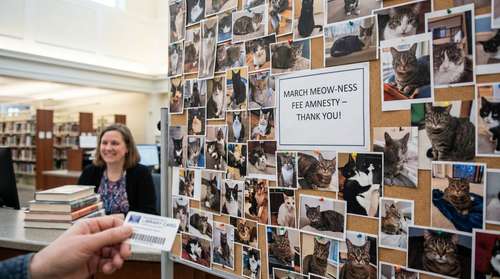
If you have ever avoided a public building because of a lingering, embarrassing late fee, one Massachusetts institution just offered the ultimate solution. In what might be the most wholesome strategy to recover lost patrons, the Worcester Public Library has officially cleared over 3,000 overdue accounts. Their currency of choice? Worcester Public Library cat photos. The brilliant initiative, dubbed "March Meow-ness," allowed residents to settle outstanding balances for lost or damaged books simply by presenting a picture of a feline.
The Genius Behind March Meow-ness Library Fees
For many readers, a misplaced book can result in an unexpected exile. Once late fees pile up, individuals often feel too ashamed or financially strapped to return to their local branches. Recognizing this frustrating barrier, library officials launched the March Meow-ness library fees forgiveness campaign to welcome readers back with open arms—and paws.
Patrons who had lost or damaged items for at least two months were granted full amnesty. Executive Director Jason Homer spearheaded the initiative with a clear philosophy: librarians want people checking out books, not stressing over penalties. Homer explained that the library is constantly looking for ways to reduce barriers, noting that many people lost track of materials due to housing displacement or the chaos of the global pandemic. By tapping into the universal internet love for felines, the library staff transformed a punitive interaction into a joyous community exchange.
From Professional Portraits to Crayon Sketches
The rules of the exchange were famously lenient. You did not need to own a purebred Maine Coon to participate. Librarians accepted everything from high-definition professional pet portraits to frantic, hand-drawn crayon sketches of cats. If a patron lacked artistic skills, a printed picture of a famous internet cat, a shelter animal, or even a majestic lion or tiger satisfied the requirement. The sheer inclusivity of the program ensured that anyone could participate, regardless of their pet-ownership status or drawing abilities. This flexibility became a cornerstone of the viral cat news stories that soon swept across social media platforms.
Funny Local News Massachusetts: A Community Reconnected
When this story first hit the airwaves, it instantly became a top piece of funny local news Massachusetts residents could rally behind. But beyond the humor of handing a library employee a poorly sketched stick-figure cat to clear a $20 debt, the underlying impact was profoundly human.
To fully understand the gravity of the initiative, you have to look at what modern libraries actually provide. Worcester Public Library offers far more than just paperback novels. Patrons rely on the institution for vital resources. They provide access to high-speed internet, free movie rentals, and a dedicated "Library of Things" that includes practical items like sewing machines, electronic readers, and projectors. When a resident is locked out of their account over a misplaced item, they lose access to this entire ecosystem of support.
Over 3,000 local readers had their library privileges fully restored thanks to this effort. That represents thousands of children, students, and seniors who can now freely access these critical community spaces. Forgiving these debts removed a heavy burden that disproportionately affects lower-income families. The Massachusetts library late fees issue was solved not through rigid policy enforcement, but through radical empathy and a shared laugh.
The Broader Impact of Library Fee Amnesty 2024
While Worcester's approach was uniquely feline-focused, it highlights a much larger shift in how public institutions operate today. The library fee amnesty 2024 movement is gaining serious momentum nationwide. Traditional late fees are increasingly viewed as an outdated administrative hurdle rather than an effective way to manage inventory.
City officials across the country are recognizing that financial penalties do not always teach responsibility; they often merely drive away the demographics that need free public resources the most. Major systems, including the Los Angeles Public Library, have previously moved to eliminate standard overdue fines entirely, citing the severe burden placed on students and families with limited disposable income.
However, charges for definitively lost or physically damaged materials often remain on the books even in fine-free systems. Worcester's strategy targeted those specific, harder-to-forgive charges. By offering a clean slate in exchange for a simple drawing, they managed to recover community trust rather than chasing a few dollars in lost revenue. The financial hit of replacing a damaged book is minor compared to the social cost of permanently losing a reader.
Setting a New Standard for Creative Library Programs
The overwhelming success of the March Meow-ness campaign offers a masterclass in community engagement. It proves that local government entities do not have to be boring or overly bureaucratic to be effective. By leaning into the inside joke that all librarians are inherently cat people, the staff created one of the most engaging creative library programs in recent memory.
Other municipalities are undoubtedly taking notes. As libraries continue to evolve from quiet reading rooms into vital neighborhood hubs offering extensive digital and physical tools, maintaining open doors is absolutely essential. For Worcester, a simple stack of cat photos was all it took to tear down the financial walls keeping thousands of readers away. The next time you misplace a novel, you might want to start practicing your cat-drawing skills—just in case your local branch decides to follow suit.