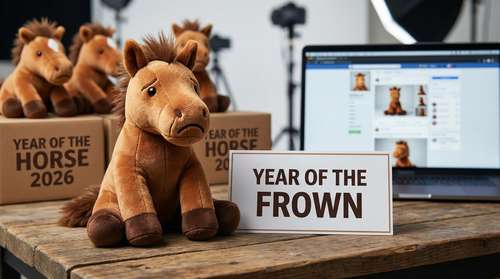
It was supposed to be a symbol of unbridled joy for the upcoming Lunar New Year. Instead, a manufacturing error in a Chinese factory has birthed the internet's most relatable mascot for 2026: the crying horse plushie. With its mouth accidentally stitched upside down into a deep, mournful frown, this red velvet equine has gone from the reject pile to a global viral sensation, perfectly capturing the existential dread of the modern workplace.
The Great Yiwu Manufacturing Fail
The story began in Yiwu International Trade City, known as the world's wholesale capital. At the "Happy Sister" toy shop, owner Zhang Huoqing was preparing a massive batch of cheerful red mascots to celebrate the incoming Year of the Horse 2026. The design was standard fare: a festive red coat, a golden bell, and a beaming smile symbolizing prosperity.
However, during a rush on the assembly line, a worker accidentally inverted the mouth template for an entire batch. The result was a horse that looked less like it was galloping towards fortune and more like it had just opened an urgent email at 4:55 PM on a Friday. "A worker sewed the mouth on upside down by accident," Zhang told reporters. "We thought it was a disaster. Who would want a sad New Year's charm?"
From Factory Reject to Viral Sensation
The turning point came when a customer in Hangzhou received one of the defective units. Instead of returning it, they posted a photo on social media with the caption: "This horse is me." The image exploded on Douyin (China's version of TikTok) and Weibo, igniting a firestorm of engagement. The hashtag #YiwuCryCryHorse has since garnered over 100 million views.
Social media users immediately latched onto the toy's "ugly-cute" aesthetic. In a sea of polished, hyper-positive influencer content, the accidental toy manufacturing fail stood out for its raw, unintentional honesty. It wasn't trying to be cute; it was just trying to survive—a sentiment that resonated deeply with Gen Z and Millennial workers.
Why the 'Sad Horse' Is the Moment
The 'Niu Ma' Culture Connection
The viral success isn't just about a funny face; it's rooted in modern work culture. Young professionals in China often refer to themselves as niu ma (literally "cattle and horse"), a slang term for workers who toil endlessly with little reward. The crying horse plushie has become the physical embodiment of this term.
One top comment on a viral video summed up the mood: "The smiling horse is how I look when I clock out. The crying horse is how I look during the morning stand-up meeting." This dichotomy has turned the $4 toy into a desk staple, serving as a silent, plush method of protest against burnout and the notorious "996" work culture.
Sales Soaring Past the Smiles
Ironically, the error has been more profitable than perfection. Zhang Huoqing reported that while the correct, smiling versions sat on shelves, the frowning variants were selling out within minutes. The factory has since opened 10 additional production lines just to replicate the "mistake," churning out over 15,000 sad horses a day to meet global demand from the US, South Africa, and Southeast Asia.
A New Era of 'Ugly-Cute' Collectibles
The Year of the Horse 2026 trends are shifting away from traditional perfection. Following the massive success of "ugly-cute" toys like Pop Mart's Labubu in previous years, consumers are increasingly drawn to imperfections. Market analysts suggest that in an AI-generated, filtered world, physical flaws feel more authentic and human.
The phenomenon proves that in 2026, reliability beats positivity. As the Lunar New Year approaches on February 17, millions of homes won't just be decorated with symbols of wealth and luck. They'll also host a little frowning horse—a reminder that it's okay to not be okay, even during the holidays.