
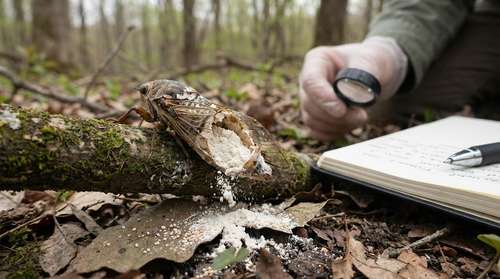
Over the past 48 hours, agricultural extension offices and entomologists across the Midwest have issued a rather disturbing spring advisory. As soil temperatures rapidly warm this week, researchers conducting field sampling have uncovered massive, lingering spore loads from a horrifying biological phenomenon: zombie cicadas. If you regularly follow weird nature news, you might be familiar with the concept of mind-controlling pathogens. However, the latest soil data reveals an explosive spread of Massospora cicadina, a specialized fungus that turns infected bugs into mindless, disease-spreading machines.
The reports published this week indicate that the local soil in affected states is heavily contaminated with these spores, perfectly timed to infect upcoming straggler emergences and annual cicadas. The result is a gruesome spectacle that researchers have colloquially dubbed the saltshaker butts phenomenon.
The Science Behind the Saltshaker Butts
When a cicada nymph emerges from infected soil, the Massospora cicadina spores latch onto its exoskeleton. As the insect molts and transforms into a winged adult, the fungus aggressively colonizes its body cavity. Within days, the infection eats away at the cicada's internal organs, eventually causing its entire lower abdomen to slough off completely.
In a normal biological scenario, losing the lower third of your body would result in immediate death. Yet these insects survive. The pathogen replaces the missing abdomen with a chalky, white plug made entirely of tightly packed fungal spores. As these mutilated bugs fly through the forest canopy, the exposed plug gradually crumbles, raining infectious white dust onto the earth below. This highly effective aerial dispersal mechanism is precisely why scientists refer to them as having saltshaker butts.
Cathinone Cocktails and Hyper-Sexual Cicadas
You might wonder how an insect continues to fly, forage, and socialize while half its body is actively rotting away. The answer lies in severe chemical manipulation. Massospora cicadina is unique among fungal parasite insects because it essentially drugs its hosts to keep them moving.
Unlike the famous Ophiocordyceps fungus that paralyzes and kills ants to sprout a stalk from their heads, this pathogen needs active, living hosts. Researchers have discovered that the fungus synthesizes cathinone, an amphetamine-like stimulant found in the illicit drug known as bath salts. This potent narcotic keeps the cicadas hyper-energized and completely suppresses their pain receptors. It also triggers a radical behavioral shift, transforming the infected bugs into hyper-sexual cicadas.
A Deceptive Mating Game
The pathogen's ultimate goal is maximum transmission, and it uses sexual contact as its primary vehicle. Infected males exhibit frantic mating behaviors, aggressively attempting to copulate with healthy females despite lacking the necessary reproductive organs. More terrifyingly, the fungus rewires the male cicada's brain, forcing him to mimic the specific wing-flicking signals typically used by receptive females.
Healthy males, drawn in by the fake signals, approach the infected male expecting to mate. Instead, they are exposed to the chalky spore plug, catching the fungal STD and spreading the outbreak even further across the dense insect population.
The Toxic Legacy of Cicada Brood 2024
The staggering spore concentrations discovered by soil researchers this week did not appear out of thin air. They are the direct, toxic legacy of the historic cicada brood 2024 emergence. Two years ago, the simultaneous hatching of Brood XIII and Brood XIX brought trillions of insects to the surface across the United States, creating a perfect storm for the pathogen.
While the deafening noise and sheer volume of the 2024 swarms dominated the news cycle, entomologists were quietly tracking the explosive spread of the fungus. Because so many insects were present, the pathogen had an infinite supply of hosts. Millions of infected bugs blanketed the forest floors with spores before dying, saturating the earth with infectious material.
This week's soil analysis confirms that those spores have remained dormant and highly viable. With spring temperatures triggering the awakening of local insect populations, the stage is set for a fresh wave of brutal infections.
What This Means for Your Backyard
For humans, pets, and local wildlife, the fungal spores pose absolutely zero physical threat. Massospora cicadina is incredibly specialized and can only survive inside the body of a cicada. You do not need to worry about walking through the woods or letting your dog sniff around the yard. In fact, birds that snack on the infected bugs simply get a mild, harmless dose of the stimulant before flying off.
However, for the local insect ecosystem, the next few weeks will be hazardous. As straggler cicadas and early-emerging annual species dig their way out of the earth, they are walking blindly into a biological minefield. Entomologists are urging citizen scientists and backyard observers to keep an eye out for these erratic, chalk-bottomed insects over the coming days.
Documenting where the zombie cicadas appear helps researchers accurately map the spread of the pathogen. If you happen to spot an insect flying in bizarre circles with a white, crumbling tail end, you are witnessing one of nature's most weirdly fascinating and ruthless survival strategies unfolding right in your backyard.