
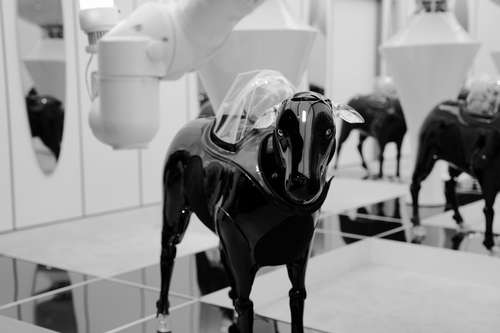
If you thought the rivalry between the world's wealthiest tech moguls couldn't get any weirder, think again. The latest battleground isn't a social media platform or a literal cage match—it is a renowned German art gallery. Welcome to the absolute pinnacle of weird news April 2026: a surreal installation where an Elon Musk robot dog can be seen roaming the floor, stopping occasionally to quite literally 'poop' out freshly printed AI images. This bizarre intersection of high culture and lowbrow humor is already generating massive waves online, perfectly capturing the chaotic essence of modern digital life while forcing audiences to question who really shapes their worldview.
The Mechanics of the 'Regular Animals' Exhibit
At Berlin's Neue Nationalgalerie, visitors are currently being treated to 'Regular Animals,' a highly interactive exhibition created by the American digital artist Mike Winkelmann, universally known to the internet as Beeple. Unveiled on April 28, 2026, the installation features advanced quadruped Unitree Go2 robots equipped with hyper-realistic silicone heads designed by professional mask-maker Landon Meier.
The robotic pack doesn't just feature the controversial Tesla CEO. Visitors will also spot a Jeff Bezos bot, a Kim Jong-un machine, an Andy Warhol model, and even a striking piece of Mark Zuckerberg mask art mounted on a mechanical hound. But these high-tech canines do more than just wander aimlessly and unnerve the gallery patrons. They are fitted with built-in cameras that actively scan the museum environment. When they enter 'Poop Mode,' an onboard generative AI system processes the visual data in real-time and instantly excretes a printed interpretation of the surroundings onto the gallery floor.
A Personalized Processing Mode
What makes this Berlin museum robot poop uniquely fascinating is the highly customized AI output. Each mechanical dog processes the world according to the perceived 'personality' and cultural impact of the figurehead it wears. For instance, the Pablo Picasso dog drops fragmented, Cubist-style prints, while the Warhol unit leaves behind bold, colorful pop-art images.
The tech billionaires, however, offer a distinctly corporate flavor of excrement. The Meta CEO robot drops prints boasting a vibrant, distorted metaverse aesthetic. The Musk variant, meanwhile, leaves behind high-contrast, monochromatic designs that directly parody his dark, ultra-modern rebranding of X. The resulting scattered prints turn the pristine museum floor into a literal data dump, symbolizing how platforms ingest our real-world data and feed it back to us in highly curated, monetized formats.
The Genius Behind the Elon vs Zuck Satire
While the sight of mechanical billionaires defecating on a polished gallery floor might seem like a cheap sight gag, Beeple's intent is surprisingly profound. This Elon vs Zuck satire serves as a sharp, unavoidable critique of how modern reality is filtered, processed, and ultimately controlled by a handful of unelected tech executives.
Historically, cultural perception was driven by painters, sculptors, and writers. 'In the past, our view of the world was shaped in part by how artists saw the world,' Beeple recently explained to reporters. Today, that immense cultural power has shifted dramatically. Now, our daily consumption of information is almost entirely mediated by algorithms owned by a few Silicon Valley tycoons. These moguls can wake up and instantly alter the global flow of news and information without passing legislation or consulting international bodies. By transforming them into data-mining, poop-manufacturing hounds, Beeple strips them of their untouchable mystique, reducing their algorithmic power to a literal, and laughable, bodily function.
The Perfect Recipe for Viral Tech Billionaire Memes
It didn't take long for footage of the exhibition to explode across social platforms, turning the event into an absolute goldmine for viral tech billionaire memes. The sheer absurdity of watching a dead-eyed, mechanical Jeff Bezos or Elon Musk awkwardly squat to print an AI-generated receipt of its surroundings is irresistible fodder for the internet.
Adding another layer of irony to the exhibit, some of the printed droppings feature QR codes that allow attendees to claim free blockchain-backed NFTs. The robotic dogs themselves are no cheap novelty, either; earlier iterations of these mechanical hounds reportedly sold for $100,000 each during Art Basel events. Beeple is essentially mocking the hyper-monetization of digital spaces while simultaneously participating in it—a brilliant paradox that has art critics and meme creators equally fascinated by the stunt.
Why Funny Robotics Stories Are Taking Over Culture
We are living in an era where technology is advancing at an intimidating, sometimes terrifying pace, making funny robotics stories a necessary release valve for societal anxiety. Generative AI tools and autonomous machines are raising serious, pressing questions about authenticity, data privacy, and human agency. Seeing these imposing, world-altering technologies repackaged as creeping, pooping parodies offers a moment of collective catharsis.
The Berlin exhibition runs through May 10, 2026, leaving plenty of time for European visitors to experience the surreal spectacle firsthand. Until then, the rest of the world will just have to enjoy the bizarre video clips flooding their feeds. Whether you view it as a profound commentary on algorithmic control or just a hilarious prank aimed at the world's richest men, the intersection of tech and art has never been quite this messy.