
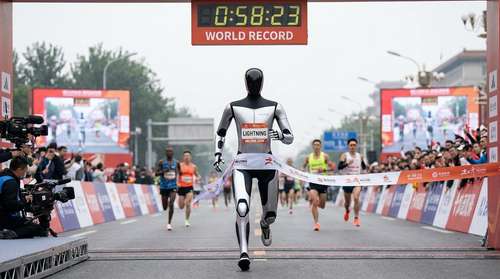
The era of human athletic supremacy might be facing its most bizarre challenger yet. In what has quickly become one of the most talked-about moments in sports history, a 5-foot-5 android named Lightning has officially shattered the humanoid robot world record—and eclipsed the ultimate human benchmark—at the second annual Beijing E-Town Half-Marathon. Completing the 13.1-mile course in an unbelievable 50 minutes and 26 seconds on April 19, 2026, the mechanical marvel easily bested the men's world record of 57 minutes and 20 seconds previously held by Ugandan runner Jacob Kiplimo.
A Historic Day at the Beijing Robot Half-Marathon
The spectacle unfolded on the streets of the Beijing Economic-Technological Development Area, colloquially known as E-Town. Thousands of traditional athletes found themselves sharing the pavement with over 100 robotic competitors, all racing on parallel, barricaded lanes to avoid high-speed mechanical collisions. This Beijing robot half-marathon was designed as an ultimate stress test for next-generation machines, pushing their endurance, balance, and battery life to the absolute limit.
The scale of the 2026 competition dwarfed previous iterations, drawing entries from more than 100 domestic and international robotics teams. While a remote-controlled counterpart technically finished faster at 48 minutes and 19 seconds, race officials crowned Lightning the true champion because it successfully navigated the entire 21-kilometer route autonomously. The android relied entirely on its onboard sensors to identify the track and maintain a relentless pace, signaling a massive leap forward for autonomous movement in dynamic environments.
The Tech Behind the Bionic Runner
Developed by Chinese smartphone manufacturer Honor, Lightning isn't just an athletic anomaly; it is a masterpiece of cross-industry engineering. To overcome the friction and intense heat generated by moving at high speeds for nearly an hour, Honor engineers equipped the bionic runner with a cutting-edge liquid-cooling system integrated directly into its joints. This technology was actually adapted from the thermal management systems used in the company's consumer smartphones, proving that mobile tech can directly fuel the robotics boom.
The course itself required each machine to execute approximately 250,000 precise joint movements over varied terrains. Nearly 40 percent of the field opted to navigate the grueling path autonomously, processing visual and spatial data on the fly without human intervention.
A Viral Robot Video Moment
Despite its eventual victory, the race wasn't entirely flawless. In a sequence that quickly spawned a viral robot video across social media feeds, Lightning slammed into a barrier near the finish line and toppled over. Yet, demonstrating remarkable structural durability, the machine managed to get back up with minor human assistance, propelling its three-foot-long legs across the finish line to seal its historic victory. Other competitors weren't as lucky; several androids stumbled, veered completely off course, or had to be carried away on stretchers after falling to pieces.
Robot vs Human Race: Erasing Previous Benchmarks
The progression of these bipedal sprinters is staggering when you look at the historical context. At the inaugural 2025 event, most of the robotic entrants overheated, lost limbs, or spun wildly out of control. Only six out of 21 machines managed to finish, with the winning time clocking in at a sluggish 2 hours, 40 minutes, and 42 seconds.
In just 12 months, the field has evolved from a clumsy tech demo to a legitimate display of athletic dominance. The top-tier machines left Sunday's fastest human runners—who crossed the line around the 1 hour and 7-minute mark—completely in the dust. For spectators witnessing this robot vs human race firsthand, the mood shifted rapidly from amusement to awe. Local attendee Sun Zhigang summarized the sentiment perfectly, noting it was the first time he had ever witnessed machines physically surpass human capabilities in such a visceral way. 'I didn't expect the speeds to be this fast already, and they're all very stable,' added another spectator, Jiang Liangzhi.
The Future of AI in Sports and Beyond
While this certainly qualifies as premium weird world news 2026, the implications extend far beyond athletic novelty. Organizers and developers view this brutal 13.1-mile course as a highly visible, public proving ground. The capabilities required to run a marathon—real-time spatial awareness, energy conservation, and dynamic balancing—are the exact same skills needed for robots to operate effectively in factories, disaster zones, and everyday households.
'Looking ahead, some of these technologies might be transferred to other areas,' explained Du Xiaodi, a development engineer at Honor. 'It's similar to how the automotive industry initially developed through competitions'.
As AI in sports continues to blur the line between science fiction and reality, the success of Lightning proves that the bipedal robotics industry is accelerating at an unprecedented rate. We are no longer just asking if robots can walk alongside us. We are now forced to wonder how much faster they will run.