
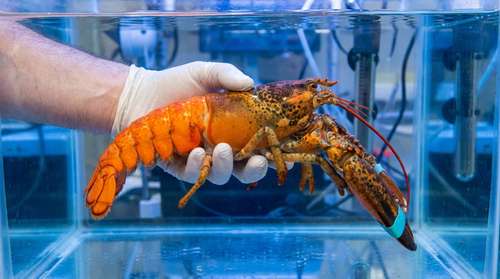
Every once in a while, the Atlantic Ocean gives up a secret so unusual it halts seasoned fishermen in their tracks. On April 16, 2026, the crew aboard the commercial fishing vessel Timothy Michael hauled up their traps off the coast of Massachusetts and found a striking biological anomaly. Inside was an incredibly rare split color lobster, neatly divided down the middle with one side dark brown and the other a bright, cooked-looking orange-red. Instead of ending up on a dinner plate bathed in melted butter, this remarkable creature has sparked a wave of Cape Cod viral news and secured a permanent home in a scientific facility.
A Catch Like No Other Off Cape Cod
The crustacean was brought ashore to the Wellfleet Shellfish Company in Eastham, Massachusetts. Dockworkers and marine enthusiasts quickly realized this wasn't a standard haul. The coloration features a sharp, straight line running perfectly from the lobster’s head all the way down to its tail fan. This distinct division creates an orange and brown lobster that looks like two different animals spliced together.
According to marine biologists, the odds of discovering a split lobster like this are about 1 in 50 million. To put that into perspective, an angler is more likely to win a massive lottery jackpot than to pull one of these from a trap. Dan Brandt, the chief operating officer at Wellfleet Shellfish Company, noted that when something this exceptional comes across the docks, the immediate instinct is to share it with the broader community rather than send it to the seafood market. The company officially announced the catch on social media on April 21, emphasizing their commitment to protecting the ocean and celebrating its wonders.
The Science Behind the Rare Two-Toned Lobster
What causes such a bizarre physical trait? The answer lies in a fascinating genetic quirk. Researchers classify this rare two-toned lobster as a chimera. The condition stems from cellular mechanics occurring at the very beginning of the lobster's development.
Aquarium biotechnician Julia Studley explained to researchers that this split coloration happens when two fertilized, unlaid eggs come into contact and fuse. Essentially, one egg absorbs the other, resulting in a single animal that carries two entirely distinct sets of genetic information. This cellular fusion dictates the pigmentation on either side of the animal’s shell, allowing it to store color differently on the left versus the right. It is a stunning visual representation of genetic mosaicism, making it one of the most sought-after rare marine specimens for both public viewing and scientific study.
Why This One in 50 Million Lobster Is a Survivor
Beyond its mesmerizing appearance, the survival of this crustacean is a minor miracle. The typical mottled dark brown shell of an American lobster serves a vital purpose: camouflage. Blending into the murky, rocky ocean floor protects them from predators like cod, haddock, and seals.
Because it sports a neon orange-red flank, this one in 50 million lobster has been wearing a visual bullseye its entire life. Yet, it managed to thrive in the wild. Weighing in at over three pounds, the animal is estimated to be several years old. Brandt pointed out that reaching this size without natural camouflage means the split lobster has already survived against staggering odds in the harsh environment of the Atlantic.
A Temporary Vacation in Woods Hole
Given its immense value to science and public education, Wellfleet Shellfish Company donated the heavy crustacean to the Woods Hole Science Aquarium in Falmouth. Operated by NOAA Fisheries, it stands as the oldest public marine aquarium in the United States.
However, the facility is currently undergoing extensive renovations and isn't slated to reopen until early 2027. For now, the lobster is enjoying an extended vacation behind the scenes at the nearby Marine Biological Laboratory. Caretakers report that she is settling in comfortably, exploring the rocky cave-like structures in her tank and dining on a steady diet of fish.
From the Traps to Massachusetts Weird News History
Oddly colored crustaceans often generate local headlines, with blue, calico, and "cotton candy" variations popping up during the spring and summer fishing seasons. While blue lobsters appear about once in every two million catches, and entirely albino "ghost" lobsters sit at the top of the rarity chart at one in 100 million, the perfectly bilaterally split shell occupies a unique sweet spot of extreme rarity and striking visual contrast. The story has quickly transcended typical Massachusetts weird news, capturing the attention of science lovers and the general public nationwide.
When the Woods Hole Science Aquarium finally opens its renovated doors next year, this lucky survivor will be one of the first animals placed on public display. Because American lobsters have incredibly long life expectancies—with some documenting lifespans of up to 100 years—aquarium staff are in no rush to name her. They plan to observe her personality and quirks over the coming months to ensure the name fits perfectly, offering future visitors a chance to see nature's wildest genetic curveballs up close.