
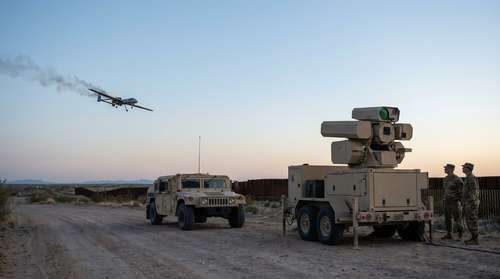
In a high-tech case of mistaken identity that reads more like a sitcom script than a military operation, the US military laser drone defense system has struck again—but this time, the target wasn't a cartel threat. It was one of their own. Late Thursday, military personnel deployed a cutting-edge laser weapon near the Texas border to neutralize what they believed was a hostile aircraft. The smoke cleared to reveal they had successfully zapped a multi-million dollar surveillance drone belonging to U.S. Customs and Border Protection (CBP).
This latest military fail at the Texas border has sparked a frenzy of finger-pointing in Washington and forced the Federal Aviation Administration (FAA) to abruptly shut down airspace near El Paso. As officials scramble to explain how two armed branches of the federal government failed to realize they were operating in the same sky, the incident has gone viral as a prime example of a government communication fail.
Laser Tag at Fort Hancock: The Friendly Fire Incident
The incident occurred near Fort Hancock, approximately 50 miles southeast of El Paso. According to reports, Department of Defense personnel spotted an unidentified unmanned aerial system (UAS) entering what they considered a restricted military operating zone. Acting on standing orders to mitigate potential threats from cartel surveillance, they engaged the target with a high-energy directed energy weapon—specifically, the LOCUST laser system.
The precision strike was effective, instantly disabling the aircraft. Unfortunately, the "threat" turned out to be a standard-issue CBP drone shot down by its own allies. "This reported engagement occurred when the Department employed counter-unmanned aircraft system authorities to mitigate a seemingly threatening unmanned aerial system," a joint statement from the FAA, Pentagon, and CBP read, in what critics are calling a masterclass in bureaucratic phrasing for "we messed up."
Deja Vu: Balloons, Lasers, and Airspace Shutdowns
For residents and pilots in West Texas, this accidental drone shooting feels painfully familiar. Just two weeks ago, a similar panic ensued when military units unleashed a laser weapon against another mysterious airborne object near Fort Bliss. That "threat" was later identified as a harmless Mylar party balloon. That incident triggered a confused 10-day ground stop at El Paso International Airport that was quickly rescinded.
This time, the FAA isn't taking chances. Following the laser weapon El Paso incident, the agency issued a Notice to Air Missions (NOTAM) effectively closing the airspace around Fort Hancock for "special security reasons" until June 24, 2026. While officials assure the public that commercial flights won't be impacted this time, the recurring shutdowns highlight a dangerous lack of coordination. The skies over the Texas border are becoming a free-fire zone where agencies seem to shoot first and ask questions later.
"Heads Are Exploding": Lawmakers React to Incompetence
The political fallout was immediate and blistering. Senior lawmakers on the House Transportation and Infrastructure Committee did not mince words regarding the government communication fail. Reps. Rick Larsen, André Carson, and Bennie Thompson released a joint statement expressing their disbelief.
"Our heads are exploding over the news that DoD reportedly shot down a Customs and Border Protection drone using a high-risk counter-unmanned aircraft system," the representatives stated. They pointed to the incident as proof of "short-sighted" decision-making and a total breakdown in inter-agency protocol. The fact that CBP did not notify the military of its flight plan—and that the military did not verify the target before firing a high-powered laser—has left legislators demanding answers about safety protocols.
A Viral "You Had One Job" Moment
While officials fume, the internet has turned the funny Texas local news story into a meme. Social media platforms are flooded with jokes about the billions of dollars spent on defense technology, only for it to be used to pop balloons and shoot down friendly aircraft. The absurdity of the situation—US tax dollars being used to destroy US tax-funded equipment—has struck a chord.
As the investigation continues, the Pentagon and CBP have pledged to "work on increased cooperation." For now, however, the message to drone operators in Texas is clear: if you're flying near the border, check your transponder, because the guy with the laser might be on your side, but he's not checking his email.