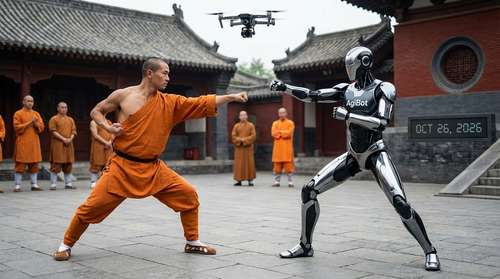
Shaolin Temple robots are no longer just the stuff of cyberpunk fiction. In a development that has left the martial arts world both awestruck and bewildered, the ancient courtyards of China's Shaolin Temple have welcomed a new breed of student: AI-powered humanoid robots. As of February 2026, visitors to the legendary monastery in Henan Province are witnessing a scene straight out of a sci-fi blockbuster—orange-robed monks sparring alongside sleek, white mechanical droids in perfect unison.
The Rise of the Iron Disciples
The viral footage, which first surfaced on Chinese social media platforms in early February 2026, shows a squad of humanoid robots developed by Shanghai-based tech firm AgiBot executing complex Kung Fu routines. These mechanical "disciples" mimic the monks' fluid movements with unsettling precision, holding horse stances (ma bu) and delivering snap kicks that rival human agility. Unlike the stiff, jerky robots of the past, these Kung Fu AI units display a level of balance and coordination that experts say marks a quantum leap in robotics.
According to reports from Global Times and CGTN, the display was part of a rehearsal for a Spring Festival gala, designed to showcase the fusion of China's oldest traditions with its newest technology trends. However, the sight of silicon-based entities training in the cradle of Zen Buddhism has sparked a global conversation about the intersection of spirituality and automation.
Tech Meets Tradition: How AgiBot Does It
The robots in question are believed to be AgiBot's latest "Lingxi" series, designed specifically for dynamic motion and environmental adaptability. While Shaolin monks sparring robots might look like a stunt, the engineering behind it is serious business. These humanoids utilize advanced motion-capture algorithms to "learn" martial arts directly from the masters. By analyzing the center of gravity and torque of high-level monks, the AI can replicate techniques that usually take decades for humans to master.
From Industrial Floors to Dojo Mats
Originally built for industrial tasks, these robots are proving that martial arts robots can serve as ultimate stress testers for hardware durability. "If a robot can maintain balance while performing a Shaolin flying kick, it can handle almost any physical challenge in a factory or disaster zone," explains a robotics analyst from Beijing. The drill isn't just for show; it's a rigorous field test for the machines' proprioception—their sense of self-movement and body position.
Weird World News 2026: The Cultural Backlash
Not everyone is bowing in respect to the new metal monks. The integration of China technology trends into sacred spaces has raised eyebrows among traditionalists. Critics argue that Kung Fu is not just about physical movement but about Qi (energy) and mental cultivation—qualities an algorithm cannot possess. Online forums are buzzing with debates: Can a robot have "Kung Fu spirit"? Is this the ultimate evolution of the art form, or a sacrilegious marketing ploy?
"It is weird seeing cold metal in a place of warm hearts and spirits," commented one user on Weibo. Yet, temple officials have framed the event as a "cultural exchange," emphasizing that the robots are tools to preserve and analyze the biomechanics of ancient styles, ensuring they are never lost to history.
The Future of Martial Arts Training
Looking ahead, the presence of Kung Fu AI at the Shaolin Temple suggests a future where technology assists in preserving intangible cultural heritage. Imagine a world where a grandmaster's movements are immortalized not just in video, but in a robot that can physically teach the next generation of human students. While we aren't quite at the level of The Matrix, this 2026 development signals that the line between ancient tradition and futuristic technology is becoming invisible.
For now, the monks continue their morning drills, the sound of their breathing now accompanied by the soft whir of servos. The ancient tradition vs technology battle has begun, and at the Shaolin Temple, it seems they have chosen to fight on the same side.