
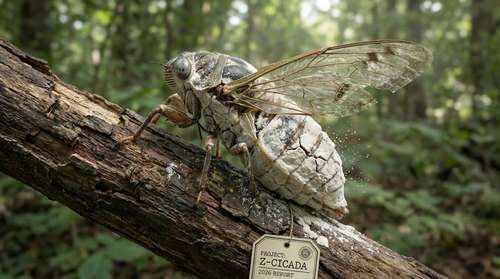
A shocking new report published this week has shed terrifying new light on the "zombie cicada" phenomenon that has captivated entomologists and horrified the public. While the historic "Cicada-Geddon" double-brood emergence of 2024 provided the raw data, scientists have just released a comprehensive analysis in February 2026 detailing exactly how the parasitic fungus Massospora cicadina turns ordinary insects into sex-crazed, spore-spreading machines. This gruesome discovery confirms that the "flying salt shakers of death" are manipulated by mind-altering amphetamines, effectively hijacking their bodies to ensure the survival of the fungal colony.
The 'Zombie' Fungus: How Massospora Cicadina Takes Control
The latest findings, highlighted in a major scientific feature released on February 4, 2026, delve into the nightmarish biology of Massospora cicadina. This white, chalky fungus lies dormant in the soil for years, waiting for cicada nymphs to emerge. Once infected, the fungus begins a ruthless takeover of the insect's body. According to the new report, the pathogen consumes the cicada's abdomen, genitals, and buttocks, replacing them with a solid plug of fungal spores. Despite having their lower bodies literally rot off, the infected insects do not die immediately. Instead, they are driven into a hyper-active state, oblivious to their own disintegration.
Key findings from the February 2026 report include:
- The fungus produces cathinone, a powerful amphetamine found in the khat plant, which acts as a stimulant to keep the host awake and active.
- Infected cicadas exhibit "prolonged wakefulness," flying continuously to spread spores over a wider area.
- The "exploding butts" phenomenon is a calculated dispersal mechanism, turning the host into an airborne crop duster of disease.
Sex-Crazed Frenzy: The Mating Manipulation
Perhaps the most disturbing revelation from the recent study is the extent to which the fungus manipulates the mating behavior of its victims. During the massive double-brood emergence, researchers observed that infected males were not only hyper-sexual but began mimicking the behavior of females. The new analysis confirms that the fungus chemically alters the insect's brain to perform a specific "wing-flick" signal typically reserved for females soliciting a mate.
This gender-bending ruse lures in healthy males, who attempt to mate with the infected "zombie" males. Since the infected male's genitals have been replaced by a fungal spore mass, the attempt results only in the transmission of the fungus to a new host. This diabolical strategy doubles the infection rate, allowing the fungus to spread rapidly through the dense swarms of a brood emergence. "It is essentially a sexually transmitted disease that turns its host into a decoy," explains one of the lead researchers referenced in the new coverage.
Nature Oddities: The Legacy of the Double Brood
The term "Cicada-Geddon" was coined during the rare convergence of Brood XIX and Brood XIII, an event that hadn't occurred since 1803. This massive influx of biomass provided scientists with an unprecedented opportunity to study Massospora cicadina at scale. The data analyzed in this week's report comes directly from specimens collected during that historic window. Researchers found that in some localized areas, the infection rate was significantly higher than previously estimated, with the "weird world news" of exploding insect parts becoming a visible reality on sidewalks and trees.
While no major broods are emerging in February 2026 due to the winter season, this new understanding of the fungal mechanism is crucial for predicting future outbreaks. The study suggests that the "resting spores" deposited during the last emergence are now dormant in the soil, waiting for the next 13 or 17-year cycle to begin the horror anew.
Why This Matters Now
The release of this research in early 2026 serves as a grim reminder of nature's complexity. The "zombie cicada" phenomenon is not just a grotesque curiosity; it represents one of the most sophisticated host-manipulation systems ever discovered. The presence of psychoactive compounds like psilocybin and amphetamines in a fungal pathogen challenges our understanding of how diseases can influence behavior. As one expert noted in the recent coverage, "The next pandemic-causing bug won't turn us into zombies, but studying these extreme cases in nature reveals just how powerful biological imperatives can be."