
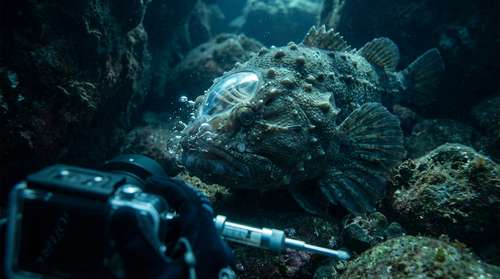
In a discovery that sounds more like heavy metal than marine biology, scientists have revealed one of nature's weirdest secrets: the rockhead poacher fish uses its own skull as a biological drum kit. This tiny, armored creature, native to the rocky Pacific coastlines from Alaska to California, has baffled researchers for over a century with a mysterious bowl-shaped cavity in its head. Now, breaking weird world news 2026 confirms that this cranial pit isn't just for show—it's a high-fidelity percussion instrument used for underwater communication.
The Mystery of the Hole in the Head
For decades, the Bothragonus swanii, commonly known as the rockhead poacher, was an enigma. Roughly the size of a human hand and covered in bony plates, it looks more like a piece of gravel than a fish. Its most perplexed feature, however, was a deep, cup-like depression in its skull, comparable in volume to its entire brain. Until recently, theories ranged from a specialized sensory organ to a camouflage aid.
New research led by Daniel Geldof at Louisiana State University (LSU) has finally cracked the code. Using high-resolution micro-CT scans, the team discovered that the fish's first pair of ribs are modified into massive, flattened biological drumsticks. These ribs are controlled by powerful muscles and tendons, allowing the fish to rhythmically strike the hard, mineralized bottom of its cranial cavity. This mechanism effectively turns the fish's head into a resonance chamber, producing vibrations that travel through the ocean floor.
Nature's Most Metal Fish: How the Biological Drum Kit Works
The mechanism is unlike anything previously seen in vertebrates. While many fish produce sound using their swim bladders, the fish drumming with skull strategy is a unique evolutionary adaptation. The rockhead poacher lives in turbulent intertidal zones where crashing waves create a chaotic acoustic environment. Traditional sound waves wash away in the noise, but substrate-borne vibrations—like those produced by a drum—travel efficiently through the rocks.
Vibrations Over Volume
When the rockhead poacher strikes its internal ribs against its skull, it generates a buzzing vibration rather than a loud boom. Researchers compare the sensation to holding a cell phone on vibrate. This method allows the fish to signal potential mates or rivals who are also resting on the sea floor, bypassing the noisy water column entirely. It represents a sophisticated solution to the challenge of communicating in a deafening environment, solidifying its place among nature's weirdest discoveries.
Why This Discovery Matters for Science
This finding highlights how much we still have to learn about bizarre sea creatures and strange animal behavior. The rockhead poacher's adaptation challenges our understanding of vertebrate anatomy and sound production. "Essentially, this fish seems to have built a percussion instrument into its head," Geldof explained in the study findings released this week. The discovery was only possible due to non-invasive imaging technology, which allowed scientists to see the internal "drumsticks" in action without dissecting the rare specimens.
As we continue to explore the oceans in 2026, creatures like the rockhead poacher remind us that evolution often improvises in surprising ways. From a mysterious hole in the head to a sophisticated communication device, this unassuming bottom-dweller has officially earned its title as the ocean's most metal fish.