If you thought ghosting was the peak of digital dating disrespect, welcome to Valentine’s Day 2026. As of this morning, a new phenomenon known as the ‘AI Situationship’ has officially overtaken ‘rizz’ as the most talked-about topic in Gen Z romance. With just a week until the holiday, millions of singles are reportedly outsourcing their love lives to algorithms, creating a bizarre landscape where chatbots flirt with chatbots while humans sit back and watch. According to a shocking report released yesterday by Forbes Health, this reliance on artificial intelligence isn't just a quirky habit—it’s a symptom of a dating culture in total collapse.
The Rise of the ‘AI Situationship’
So, what exactly is an AI situationship? Coined in a prophetic report by the dating app happn and solidified by a viral Psychology Today piece earlier this month, the term describes a relationship dynamic where one or both parties rely heavily on AI to mediate their connection. This goes beyond simple spell-checking. We are talking about users employing tools like Rizz and the newly controversial Three Day Rule app to draft every text, analyze every emoji, and even simulate arguments before they happen.
For many Gen Z daters, the AI situationship offers a form of “emotional training wheels.” It’s a low-stakes environment where they can practice vulnerability with a bot before risking rejection from a human. However, critics argue this is creating a generation incapable of authentic intimacy. Dr. Justin Garcia of the Kinsey Institute, in an interview released just this week, warned that while these tools are intended to be aids, they are rapidly becoming crutches that strip the spontaneity out of romance.
Bot-to-Bot Romance: The Dead Internet Theory of Dating
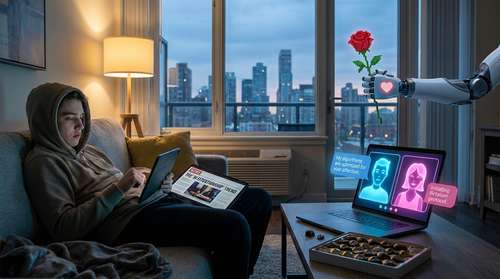
The most dystopian development of 2026 dating trends is the realization that many conversations on dating apps no longer involve humans at all. On Wednesday, a scathing review of the AI-powered matchmaking service Three Day Rule went viral after a reviewer discovered that her matches were opening with identical, AI-generated lines. The implication is terrifying: we have reached a point of "bot-to-bot" romance, where your AI agent flirts with my AI agent, and we only step in to schedule the physical date—if we get that far.
This automation of AI dating rizz has led to a surreal homogenization of flirtation. When everyone is using the same Large Language Model (LLM) to maximize their appeal, personality quirks are smoothed out in favor of algorithmically optimized "charm." The result? A digital dating pool that feels incredibly polished but eerily hollow.
Why We Are Burned Out: The 78% Statistic
Why are we voluntarily handing our hearts over to machines? The answer lies in severe dating app burnout. A landmark survey published yesterday, February 5, by Forbes Health, revealed a staggering statistic: 78% of dating app users feel "exhausted" by the endless cycle of swiping. The survey highlights that for the average user, the effort required to maintain a conversation has eclipsed the reward of a potential connection.
In this context, the AI situationship becomes a survival mechanism. If you are too burnt out to be witty, you let the bot do it. If you are too anxious to break up, you let the AI draft the text. It is efficiency at the cost of humanity, a trade-off that nearly half of Gen Z seems willing to make as we approach Valentine's Day 2026.
The Clinical Breakup: AI’s Final Insult
The trend doesn't end at the meet-cute. It extends to the breakup. We are seeing a surge in AI breakup texts, a phenomenon fueled by new features in operating systems like Apple Intelligence, which can brutally summarize long, emotional breakup messages into bullet points like "No longer in a relationship; wants belongings returned."
Just yesterday, Hello! Magazine profiled a woman who "replaced therapy with AI" to get through a split, highlighting a growing reliance on chatbots for emotional regulation. While efficient, this trend risks turning the messiest, most human parts of our lives into administrative tasks. As we head into a Valentine's Day dominated by Gen Z digital romance innovations, the question remains: If an AI woos you, dates you, and dumps you, did the relationship ever really exist?