
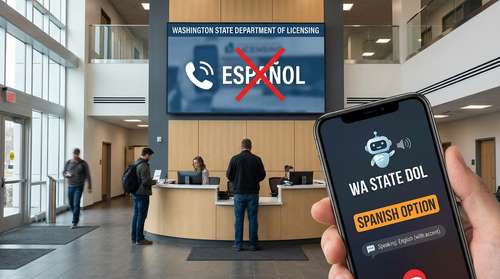
Callers to the Washington State Department of Licensing (DOL) this week were left scratching their heads—and checking their ears—after a bizarre AI voice glitch 2026 turned a routine government interaction into a viral comedy sketch. Residents attempting to access the Spanish-language option on the state's licensing hotline were greeted not by a Spanish speaker, nor a translation, but by an artificial intelligence voice reading English text with a heavy, exaggerated Spanish accent. The incident, which has been dubbed a major Washington state AI fail, quickly trended on social media after a resident's recording exposed the absurdity of the situation.
The 'Spanglish' Glitch That Went Viral
The issue came to light when Washington resident Maya Edwards posted a video to TikTok that has since garnered over 2 million views. In the video, Edwards demonstrates what happens when callers press "2" for Spanish. Instead of switching languages, the automated system continues to speak English, but with a distinct, computer-generated Castilian accent. The voice can be heard struggling through standard prompts, pronouncing English words using Spanish phonetic rules, resulting in a surreal audio experience that sounds like a caricature rather than a government service.
"It was hilarious to us in the moment because it was so absurd," Edwards told reporters, comparing the experience to a scene from the political satire show Parks and Recreation. However, the humor was mixed with frustration. Edwards discovered the glitch when her husband, a native Spanish speaker, tried to get information about his driver's license and found the "Spanish" option effectively useless for anyone who didn't actually speak English.
Technical Breakdown: When AI Reads, But Doesn't Translate
Tech experts and sleuths have identified the likely culprit behind this funny tech news story as a configuration error involving Amazon Web Services' (AWS) text-to-speech tool, Amazon Polly. The specific voice used appears to be "Lucia," a voice profile designed to speak European Spanish. The error suggests that instead of feeding the AI translated Spanish text, the system was fed English script while set to the "Spanish" voice mode.
The result was a literal reading of English words through a Spanish linguistic filter. For example, the number "1" was read as "uno," and phrases like "wait time" were delivered with rolled R's and Spanish vowel sounds, but the words themselves remained English. This distinction is crucial: the AI wasn't trying to mock an accent; it was simply a machine following conflicting instructions—reading English input with Spanish pronunciation rules.
Official Apology from the Department of Licensing
Following the online uproar, the Washington State Department of Licensing issued a formal apology and temporarily disabled the faulty option. In a statement released Friday, a DOL spokesperson described the incident as an "unfortunate byproduct of expanding services" and attributed it to a "technical glitch" resulting from a recent system configuration change.
"DOL apologizes for the error and to its customers for any inconvenience," the agency stated, emphasizing that the move to a new AI-driven system was intended to improve accessibility by supporting 10 different languages. Officials noted they are "closely monitoring the self-service option to ensure the problem doesn't reappear."
Accessibility Concerns Beneath the Laughter
While the Department of Licensing Spanish accent blunder has provided plenty of fodder for late-night jokes and LOL news today, it highlights a serious issue regarding the deployment of AI in critical government services. For non-English speakers, the failure wasn't just a funny glitch; it was a barrier to essential services. A native Spanish speaker expecting assistance in their language would have found the "accented English" completely unintelligible.
"It has real accessibility issues for people who call in every day and need to speak in a different language other than English," Edwards noted in her follow-up comments. The incident serves as a stark reminder that while AI tools offer cost-effective ways to scale multilingual support, they require rigorous human oversight to avoid turning public service portals into unintentional cultural caricatures.
A Pattern of Government AI Stumbles?
This Washington state Spanish option fail is not an isolated incident in the growing trend of government automation. As agencies rush to adopt cost-saving AI technologies in 2026, quality control can sometimes fall through the cracks. Similar to previous incidents where chatbots gave legally binding bad advice or hallucinated non-existent policies, the Washington DOL case underscores the "human in the loop" necessity. For now, Washingtonians calling the DOL can expect a return to standard—albeit less entertaining—phone trees while the state irons out the kinks in its digital transformation.