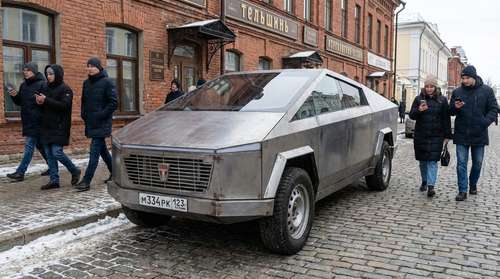
Just when you thought the Tesla Cybertruck couldn't get any more polarizing, a snowy city in Russia has said, "Hold my vodka." A bizarre, boxy, and undeniably hilarious Cybertruck knockoff has been spotted cruising the streets of Perm, Russia, effectively breaking the internet this week. Unlike the high-tech marvel produced in Austin, Texas, this Tesla Russia copycat looks like it was rendered on a PlayStation 1 and welded together in a fever dream. Dubbed the "Cybervan," this stainless steel spectacle is actually a serious attempt to revive a dead automotive brand, but the internet sees it differently: as the ultimate DIY Tesla meme.
The Russo-Balt F200: A Tsar-Era Brand Meets Cyberpunk DIY
While it looks like a garage experiment gone wrong, this vehicle is officially called the Russo-Balt F200. It represents a bold—and slightly confused—attempt to resurrect the Russo-Baltique brand, a legendary manufacturer that once supplied cars to the Russian Tsar over a century ago. Spotted in late January and early February 2026, the van features the Cybertruck's signature unpainted stainless steel finish and sharp, aggressive angles, but adapted into a delivery van format.
The company behind it, based in Perm, Russia, claims the vehicle is a revolution in electric transport. They are even offering a staggering 100-year warranty on the stainless steel body—a promise that's easy to make when your car looks like an industrial refrigerator on wheels. Despite the high-minded marketing, locals and netizens alike were quick to spot the uncanny valley effect of its "low-poly" design against the backdrop of drab Soviet-era apartment blocks.
What is Actually Under the Metal?
Beneath the jagged metal sheets lies a secret that is less "Russian engineering" and more "global supply chain." Automotive sleuths have identified the donor vehicle as likely being a Weiqiao V90, a Chinese electric commercial van. The Russian startup appears to have taken this modest Chinese EV and clad it in crude, hand-welded stainless steel panels to mimic Elon Musk's angular aesthetic.
Specs That Might Surprise You
According to the "revived" manufacturer, the F200 isn't just a pretty (or ugly) face. They claim it boasts a range of roughly 250 miles (400 km) and features a heated interior designed specifically for brutal Russian winters—including heated seats, steering wheel, and even heated windshield wipers. The price tag? A cool 6.5 million rubles (approximately $85,000), which is a steep ask for what effectively looks like a weird custom car built for a post-apocalyptic movie set.
Winning the Internet: "We Have Cybertruck at Home"
As soon as images of the vehicle hit social media platforms like Pikabu, VK, and Reddit, the Elon Musk memes began flowing. The sheer absurdity of seeing a futuristic-wannabe van navigating slushy, pothole-ridden streets in Perm struck a chord with millions. The contrast between the sleek cyberpunk aspiration and the gritty reality of a Russian winter created instant comedy gold.
One viral comment summed it up perfectly: "Mom, can we have a Cybertruck? No, we have Cybertruck at home." Others have compared the vehicle's aesthetic to a "dumpster," a "file cabinet," or a prop from a low-budget 1980s sci-fi film. The vehicle's flat, vertical rear end and awkward proportions have earned it the nickname "Cyberbuhanka," a nod to the classic, loaf-shaped UAZ vans that have roamed Russia for decades.
Why This "Cybervan" Matters Right Now
This viral weird news story is more than just a funny picture; it highlights a unique moment in the Russian automotive market. With Western brands like Tesla officially absent due to sanctions, and Chinese automakers filling the void, local builders are getting creative. The "Cybervan of Perm" sits at the intersection of necessity, absurdity, and genuine ingenuity.
Whether you see it as a legitimate innovative effort or the funniest DIY Tesla project since the cardboard copies of 2019, one thing is certain: the Russo-Balt F200 has captured the world's attention. It proves that you don't need billions of dollars in R&D to go viral—you just need some stainless steel, a welding torch, and the audacity to drive a polygon on wheels through the snow.