
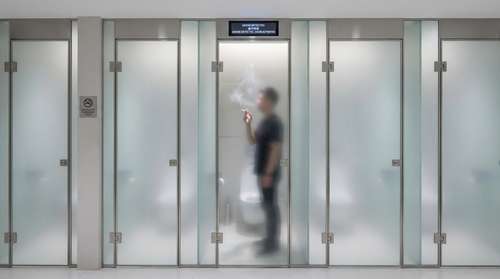
Imagine settling into a public restroom stall for a moment of privacy, only for the door to suddenly vanish before your eyes, leaving you exposed to a busy hallway of shoppers. For smokers in Shenzhen, China, this nightmare scenario is now a high-tech reality. In a controversial move to curb indoor tobacco use, shopping centers in the city’s Luohu district have begun trialing smart glass bathroom doors that automatically turn transparent the moment cigarette smoke is detected.
The Ultimate Public Shaming Mechanism
The new system, currently installed at the Shuibei International Center and Shuibei Jinzuo Building, utilizes electrochromic "smart glass" technology. Under normal conditions, the glass panels remain frosted and opaque, ensuring complete privacy for the occupant. However, the stalls are equipped with sensitive high-tech smoke detectors. If a user lights a cigarette, the sensors trigger a system that cuts power to the glass panels, rendering them crystal clear within seconds.
To ensure no one misses the spectacle, the transparency switch is accompanied by an audible alarm. The intent is clear: public humiliation as a deterrent. Signs plastered on the stall doors deliver a blunt warning to would-be violators: "The glass will turn transparent if you smoke. Control your urge if you don't want to become famous online."
Desperate Measures for Smoke-Free Spaces
Shenzhen has some of China's strictest anti-smoking regulations, with comprehensive bans on indoor smoking in public venues. Yet, mall management reports that restrooms have long served as safe havens for violators who ignore traditional signage and fines. According to a spokesperson for the Shuibei Jinzuo mall, previous attempts to police restroom smoking failed because offenders could simply lock themselves away. "We previously handled numerous smoking complaints daily," the operations director noted. "Cleaning staff reported strong smoke odors affecting hygiene, and there were safety risks with cigarette butts in trash bins."
The introduction of the transparent doors marks a shift from passive enforcement to active, technology-driven deterrence. By removing the physical barrier of privacy, the malls have effectively weaponized the fear of "social death"—a popular Chinese slang term for extreme public embarrassment—to enforce compliance.
Privacy Concerns vs. Public Health
The initiative has sparked a fierce debate across Chinese social media platforms this week. Supporters argue that second-hand smoke in confined spaces like restrooms is a health hazard that overrides the smoker's right to privacy. "Finally, a ruthless solution for a ruthless habit," one user commented on Weibo, applauding the measure.
However, legal experts and privacy advocates are raising alarms about potential malfunctions. The concern is not just about smokers, but about the technology failing and exposing an innocent person. While the mall administration claims the sensors are calibrated strictly for tobacco smoke, the fear of a false positive—triggered perhaps by an e-cigarette or other vapors—remains. To mitigate this, management has promised to install manual reset buttons, though it remains unclear if a panicked user could reach them in time.
A Viral Trend with Global Implications
Footage of the doors in action has circulated globally over the last 48 hours, drawing a mix of horror and amusement from international observers. While transparent public toilets have existed before—most notably in Tokyo, where they are used to show cleanliness and then turn opaque when locked—the weaponization of transparency for behavioral correction is a uniquely aggressive application.
As this "weird news" story continues to trend in early 2026, it raises questions about the future of surveillance in private spaces. For now, visitors to Shenzhen's Shuibei district face a simple choice: wait until they are outside, or risk becoming the unwilling star of the next viral video.