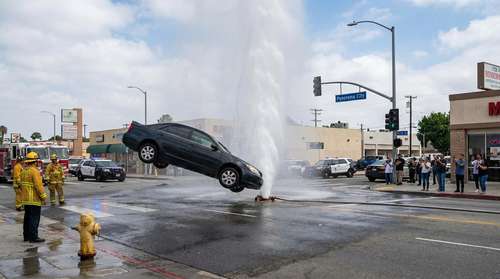
A silver compact car in Panorama City gave 'flying car' a whole new meaning this week after striking a fire hydrant that sent a high-pressure geyser shooting into the air. The water pressure was so intense it lifted the front of the vehicle completely off the asphalt, leaving it suspended in mid-air in a bizarre scene captured on security cameras. The Panorama City levitating car incident has since gone viral, stunning viewers with the sheer power of Los Angeles' municipal water infrastructure.
The Incident: How a Fire Hydrant Geyser Lifted a Car
The bizarre crash occurred on Tuesday afternoon along the 13600 block of Roscoe Boulevard, just east of Ventura Canyon Avenue. At approximately 12:56 p.m., surveillance footage captured a silver compact sedan traveling eastbound when it suddenly swerved—reportedly to avoid another collision. The defensive maneuver sent the vehicle careening off the roadway and directly into a yellow curbside fire hydrant.
Upon impact, the hydrant was sheared completely off its base, unleashing a massive, vertical column of water. Unlike typical fire hydrant geyser LA incidents where water sprays outward, the positioning of the car directly over the shear point created a physics-defying spectacle. The high-pressure torrent struck the undercarriage of the sedan with such force that it lifted the front wheels several feet off the ground, leaving the car precariously balanced on a pillar of water.
Viral Car Accident Video Takes Social Media by Storm
Within hours of the crash, the viral car accident video began circulating on platforms like X (formerly Twitter) and TikTok, racking up millions of views. Users were quick to dub the event "Look Ma, No Tires!" as the footage showed the vehicle bobbing gently atop the water jet, looking more like a carnival ride than a traffic accident.
"I've lived in LA my whole life and seen plenty of sheared hydrants, but I've never seen a car suspended on water like that," said a local business owner who witnessed the aftermath. "It looked like a magic trick. The back wheels were on the ground, but the nose was pointing at the sky, just floating there."
This weird Los Angeles news story has sparked debates online about the immense pressure contained within the city's water mains, which can range from 60 to over 200 PSI depending on the location and elevation.
LAFD Response to the High Pressure Water Main Crash
The Los Angeles Fire Department (LAFD) arrived on the scene shortly after 1:00 p.m. to find the street flooded and the vehicle still airborne. Dealing with a high pressure water main crash presents unique challenges for first responders; the water flow must be shut off remotely or via an upstream valve before the vehicle can be safely approached or lowered.
Firefighters worked quickly to locate the street valve, gradually reducing the pressure. As the water subsided, the silver sedan slowly descended back to the pavement. According to preliminary reports, the driver was shaken but miraculously avoided serious injury. Paramedics assessed the motorist at the scene, and no hospitalization was required.
The Physics Behind the Lift
How can water lift a 3,000-pound vehicle? It comes down to surface area and pounds per square inch (PSI). If a water main is pumping at 100 PSI and that water hits a large flat surface—like the bottom of a car's engine block—the lifting force can easily exceed the weight of the vehicle's front end. This LAFD fire hydrant incident serves as a potent reminder of the raw energy flowing beneath city streets.
Traffic Impacts and Safety Reminders
The incident caused significant traffic delays on Roscoe Boulevard as crews worked to clear the debris and cap the broken line. Water service in the immediate vicinity was temporarily disrupted but restored by late afternoon. Authorities are using the viral moment to remind drivers to remain alert, as swerving to avoid minor accidents can sometimes lead to more severe, albeit spectacular, outcomes.
While the Panorama City levitating car will likely go down as one of 2026's strangest traffic anomalies, it highlights the unpredictable nature of urban driving. For now, the driver is likely just thankful to be back on solid ground.