If you checked into a trendy boutique hotel this week expecting a little privacy, you might have been in for a rude awakening. A bizarre design trend has reached a boiling point in early February 2026, leaving travelers across the globe asking one frantic question: Where did the bathroom door go?
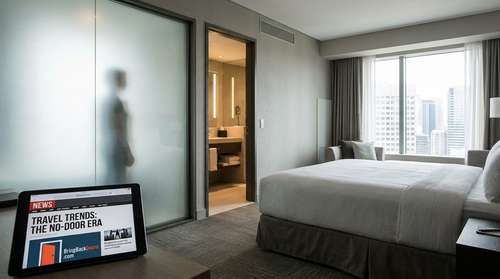
From New York to Tokyo, guests are reporting a shocking disappearance of solid barriers between the bed and the toilet. In their place? Frosted glass panels that leave nothing to the imagination, sliding barn doors that refuse to close, or worst of all—open-concept alcoves that turn private moments into a spectator sport. While hoteliers claim it’s about "modern aesthetics" and "flow," industry insiders reveal a more cynical truth: your privacy is being sacrificed to pad the bottom line.
The CFO's Secret: Doors Are a "Money Pit"
Why would a luxury hotel remove a basic necessity? According to recent reports from The Wall Street Journal and hospitality insiders, the answer is simple: money. In the eyes of hotel Chief Financial Officers (CFOs), a traditional bathroom door is a financial liability.
Think about it. A solid door requires hinges, a handle, a lock, and a frame. It needs painting, alignment, and constant cleaning. Guests slam them, kids swing on them, and humidity warps them. By swapping a solid door for a sliding glass panel—or removing it entirely—hotels save hundreds of dollars per room in construction and maintenance costs. One industry expert bluntly noted this week that eliminating doors cuts down on "moving parts," effectively solving a maintenance headache by passing the discomfort on to you.
The "Open Concept" Illusion
Designers have a different spin, of course. They argue that in increasingly shrinking hotel rooms, a swinging door eats up valuable square footage. Removing it, they claim, creates an "open concept" that makes a cramped 200-square-foot room feel like a spacious sanctuary.
"It’s about borrowing light and creating a spa-like atmosphere," one design consultant told reporters. But for guests, that "spa-like" vibe quickly evaporates when they realize the "open flow" means their roommate can hear, smell, and see everything. The trend of placing sinks and showers directly in the bedroom—sometimes just feet from the pillows—might look good on Instagram, but it fails the basic functionality test of actual travel.
The "Peek-a-Boo" Problem
The most egregious offenders are the "peek-a-boo" bathrooms enclosed in glass cubes. While often frosted for "modesty," these partitions frequently leave clear gaps at the top and bottom. At night, turning on the bathroom light transforms the enclosure into a glowing lantern, waking up everyone in the room and projecting a silhouette show that no one bought a ticket for.
Travelers Fight Back: The "Bring Back Doors" Movement
The backlash has officially gone viral. As of February 2026, fed-up travelers are rallying behind a new champion: Sadie Lowell, the founder of BringBackDoors.com. Lowell launched the site after a "traumatizing" trip to London where she had to share a doorless hotel room with her father. "It wasn't just a slight inconvenience," she said. "I was angry."
Her website has become an essential tool for modern travel, cataloging hotels based on their "Privacy Rating." Properties are flagged with warnings like "Zero Privacy" or "Glass Cube Alert," allowing prospective guests to avoid awkward encounters. The site's traffic has spiked in recent days as major news outlets like the Jerusalem Post and CNN have picked up the story, highlighting just how widespread the issue has become.
Nightmare Stories from the Front Lines
The internet is currently awash with funny hotel stories that are only funny in hindsight. Business travelers sharing rooms to save budget are finding themselves in excruciatingly intimate situations with colleagues. One viral review from a guest at a high-end Miami hotel lamented, "I love my husband, but after 25 years of marriage, I still don't want to see him 'spread eagle' through a glass pane while I'm trying to watch the news."
Another traveler reported checking into a room where the toilet was simply behind a curtain next to the minibar. "I felt like I was performing a one-man show every time I needed to use the facilities," they wrote. "Who approves these designs?"
Will Privacy Return in 2026?
Despite the uproar, the trend shows few signs of slowing down. The cost savings are too tempting for hotels facing rising labor and energy prices. However, the sheer volume of complaints might force a pivot. As "quiet luxury" becomes the buzzword for 2026 hospitality design, guests are beginning to demand that "quiet" includes acoustic separation for the bathroom.
Until then, savvy travelers are advised to check guest photos—not just the glossy marketing shots—before booking. If you see a sliding barn door or a glass wall, you might want to pack some noise-canceling headphones and a blindfold. Or better yet, check BringBackDoors.com and find a hotel that still believes in the luxury of a solid wooden door.