
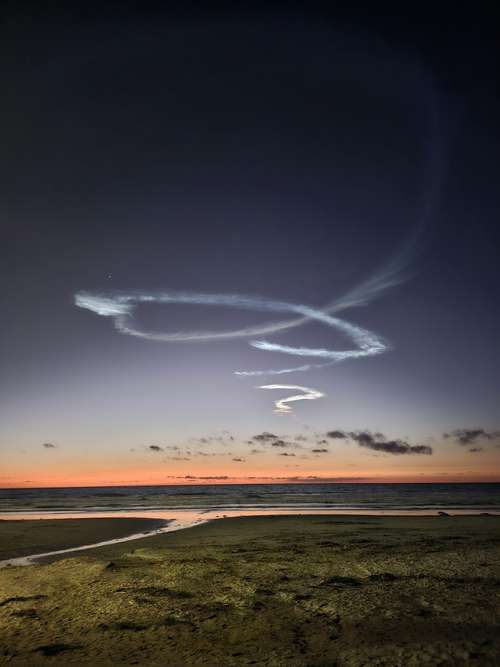
A streak of fire tore across the pre-dawn sky over the Pacific Ocean early this morning as the SpaceX Crew-11 mission made a spectacular return to Earth, capping off a historic and unexpected journey. After 166 days in orbit, the Dragon Endeavour capsule splashed down safely off the California coast at 3:41 a.m. EST, bringing four astronauts home in the first-ever medical evacuation from the International Space Station (ISS).
Dragon Endeavour's Fiery Re-entry Footage
Observers along the West Coast were treated to a breathtaking light show as the spacecraft carved through the atmosphere at 17,500 miles per hour. High-definition tracking cameras captured the plasma trail—a brilliant, glowing fireball enveloping the capsule as its heat shield withstood temperatures up to 3,500 degrees Fahrenheit.
“Dragon, welcome back to Earth,” mission control radioed moments after the main parachutes deployed, slowing the descent to a gentle 15 mph. The capsule landed in the dark waters near San Diego, where recovery vessels were already waiting. Within minutes, SpaceX teams had secured the vehicle, hoisting the scorched capsule onto the recovery ship Megan to extract the crew.
First Medical Evacuation in ISS History
While the visual spectacle was familiar, the circumstances of this return were unprecedented. NASA and SpaceX executed this landing nearly a month ahead of schedule due to a medical concern involving one of the crew members. This marks the first time in the ISS's 25-year history that a mission has ended early specifically for a medical evacuation.
NASA has maintained strict privacy regarding the specific astronaut affected and the nature of the condition, confirming only that the crew member is stable and in good spirits. "The safety of our crew is the primary mission," said a NASA representative during the live stream. "Bringing Crew-11 home early was a precautionary decision to ensure access to advanced medical care not available in orbit."
The Crew of Crew-11
Returning home are NASA astronauts Zena Cardman (Commander) and Mike Fincke (Pilot), alongside JAXA astronaut Kimiya Yui and Roscosmos cosmonaut Oleg Platonov. For Cardman, this splashdown concludes her first spaceflight, while veteran Mike Fincke adds another chapter to his storied career, having now flown on the Space Shuttle, Soyuz, and Dragon spacecraft.
Mission Highlights and What's Next
Despite the abbreviated timeline, Crew-11’s mission was a scientific success. Launching on August 1, 2025, the quartet conducted hundreds of experiments, ranging from geobiology research to advanced fluid physics. They also oversaw critical station maintenance during their five-month stay.
With Crew-11 safely back on terra firma, operations aboard the orbiting laboratory have shifted. The station is currently operating with a skeleton crew of three—NASA astronaut Chris Williams and cosmonauts Sergey Kud-Sverchkov and Sergey Mikayev—until the arrival of the next rotation. NASA is now evaluating whether to move up the launch of SpaceX Crew-12, currently slated for February, to restore a full complement of seven crew members to the station.
For now, the focus remains on the safe recovery of Cardman, Fincke, Yui, and Platonov, who will be flown immediately to NASA’s Johnson Space Center in Houston for medical evaluations and reunions with their families.