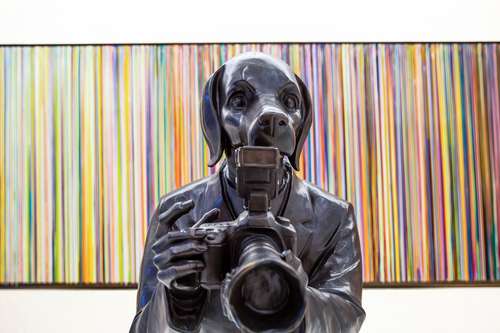
If you wander into the lower foyer of the Neue Nationalgalerie this week, you might find yourself staring into the hyper-realistic silicone face of a Mark Zuckerberg robot dog. And if you stick around long enough, you might just watch it defecate a fresh piece of algorithmic art. This bizarre, captivating scene is the centerpiece of Beeple Regular Animals Berlin, the latest must-see cultural event taking over the German capital.
Opening on April 28, 2026, and running through May 10 to coincide with Gallery Weekend Berlin, this surreal menagerie is the brainchild of digital art provocateur Mike Winkelmann, universally known as Beeple. Famous for upending the traditional art market with a record-breaking $69 million digital collage in 2021, Beeple is now bridging the gap between the internet and the physical world. His pack of mechanical hounds isn't just a spectacle—it is a pointed critique of the invisible technological infrastructures dictating our daily lives.
The Mechanics of Pooping Robot Dogs Art
The installation features a pack of quadrupedal machines roaming freely inside a penned enclosure. These semi-autonomous hounds wear meticulously crafted, hyper-realistic heads of global power players and art legends, including Jeff Bezos, Elon Musk, Pablo Picasso, Andy Warhol, and Beeple himself.
As the beasts wander the gallery space, integrated onboard cameras continuously photograph visitors and their surroundings. An artificial intelligence system then processes these captured images through a filter mimicking the specific 'worldview' or style of the figure riding the dog. A Picasso hound, for instance, fragments reality into disjointed Cubist geometry, while the Zuckerberg bot casts the room in aggressive, metaversal red lasers. The Musk machine strips the environment down to stark, sterile technical diagrams.
Finally, the machines literally print the resulting images and eject them from their rear ends. It is an absurd, hilarious mechanism, turning pooping robot dogs art into a visceral visual metaphor for data consumption, algorithmic processing, and modern content production.
A Masterclass in Tech Billionaire Satire
Beyond the undeniable shock value of mechanical feces, the installation serves as a sharp tech billionaire satire. Beeple has explicitly designed these creations to represent the outsized, unchecked influence that a handful of Silicon Valley titans hold over global perception.
'Mark Zuckerberg and Elon Musk own algorithms that control what we see and decide how we see the world,' Winkelmann told reporters at the exhibition's opening event. He pointed out the staggering reality of their influence: when these tech executives want to alter public discourse or shift political tides, they don't have to lobby the United Nations. They don't have to battle through Congress or the European Union. They simply wake up and tweak a line of code.
Catching sight of the Elon Musk robot dog museum piece processing a crowd of onlookers into raw data drives this point home perfectly. We are all just raw material waiting to be digested by the platforms they control, packaged, and monetized.
From Miami Beach to the Heart of Europe
The work first debuted to massive viral attention at Art Basel Miami Beach in late 2025, where Beeple cheekily handed out the printed photos with certificates verifying them as '100% organic GMO-free dog shit'. Some of those early prints even contained QR codes granting attendees free NFTs. Moving the exhibit to Germany, however, places the spectacle in a much more institutional context.
The choice of city adds a potent layer of irony. Bringing this specific critique to a region where both Tesla and Amazon operate massive regional plants grounds the digital commentary in physical, economic reality.
The Beeple Berlin Exhibition 2026: Institutional Impact
The Beeple Berlin exhibition 2026 represents the artist's first major showing in Germany, and it was a deliberate, bold choice by the Neue Nationalgalerie. Lisa Botti, the curator of the exhibition, emphasized that cultural institutions can no longer afford to ignore the powerful forces of artificial intelligence and digital centralization.
By hosting this AI art installation Berlin visitors are challenged to confront the very surveillance systems observing them daily. The museum has strategically placed Beeple’s modern commentary in dialogue with legacy media works. While pioneers like Nam June Paik transformed mass media and television into sculptural form decades ago, Beeple is extending that exact legacy into the current age of generative algorithms and decentralized networks.
Whether you view it as a profound sociopolitical allegory or simply a surreal, Instagram-friendly spectacle, the pack of pooping billionaire dogs successfully accomplishes what great contemporary art should. It holds up a mirror to modern society, even if that mirror happens to be printed out of a robot’s backside.